

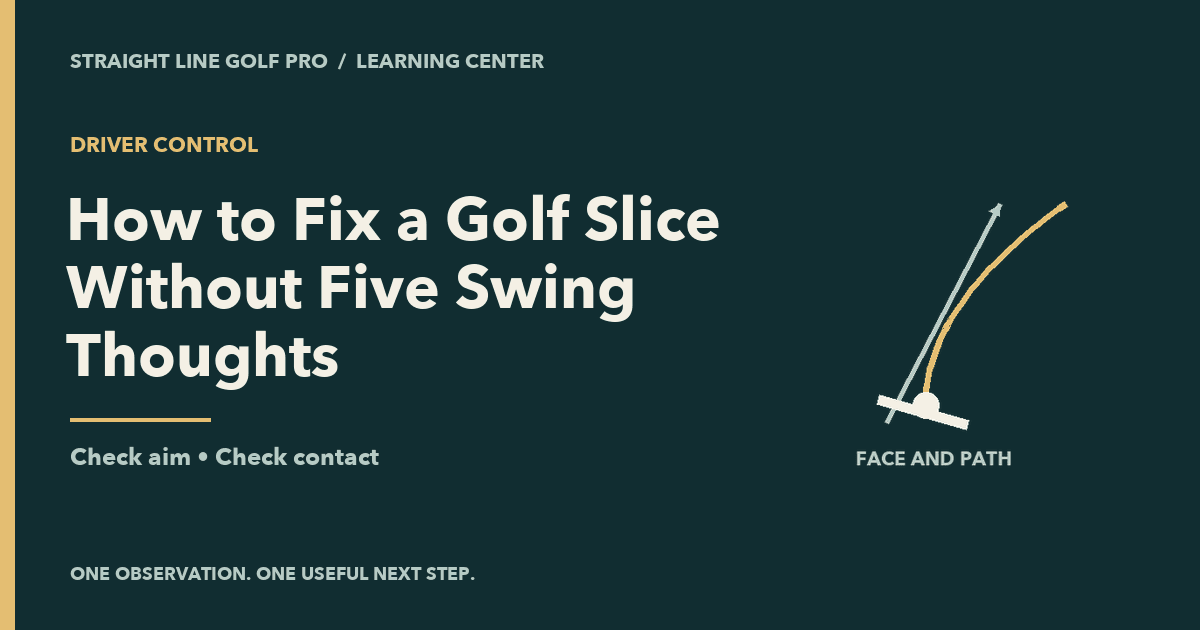
Start a slice correction by checking aim and contact, then consider how the face is delivered relative to the path. Work on one observed pattern at a time; a slice does not identify every movement that produced it.
What makes the ball curve
For centered contact, a face open relative to the path creates fade or slice curvature. The initial direction is strongly influenced by the face, but it is not simply an exact copy of face angle. Titleist: The Physics of Ball Striking.
For a right-handed golfer a slice curves right; for a left-handed golfer it curves left. A driver strike away from the center can change the flight, so include contact in the check. Do not infer exact face or path angles from an ordinary phone video.
Choose a useful first priority
Begin with a clear range target and a comfortable setup. Aim the face before settling your feet. Hit a small group at an effort you can repeat and note whether the ball starts off line, curves strongly, or does both.
If you cannot repeat the starting direction, check alignment and face control. If the start repeats but curvature remains large, contact and the face-to-path relationship are useful topics for coaching. Changing your grip, shoulder turn and release simultaneously makes it difficult to tell which change helped.
Practice without chasing an opposite miss
Use a slow rehearsal or shorter swing to test one coach-selected cue. Do not force every ball to start left, roll the hands aggressively or swing farther across the target solely because the previous ball sliced. A pull or hook is a different miss, not proof that the original problem is solved.
Use the six-shot slice worksheet to record a practice session. This overview explains the concepts; the worksheet supplies the observation sequence. If the cause remains unclear, ask Stubbs or work with a qualified coach using a clear video and contact information.