

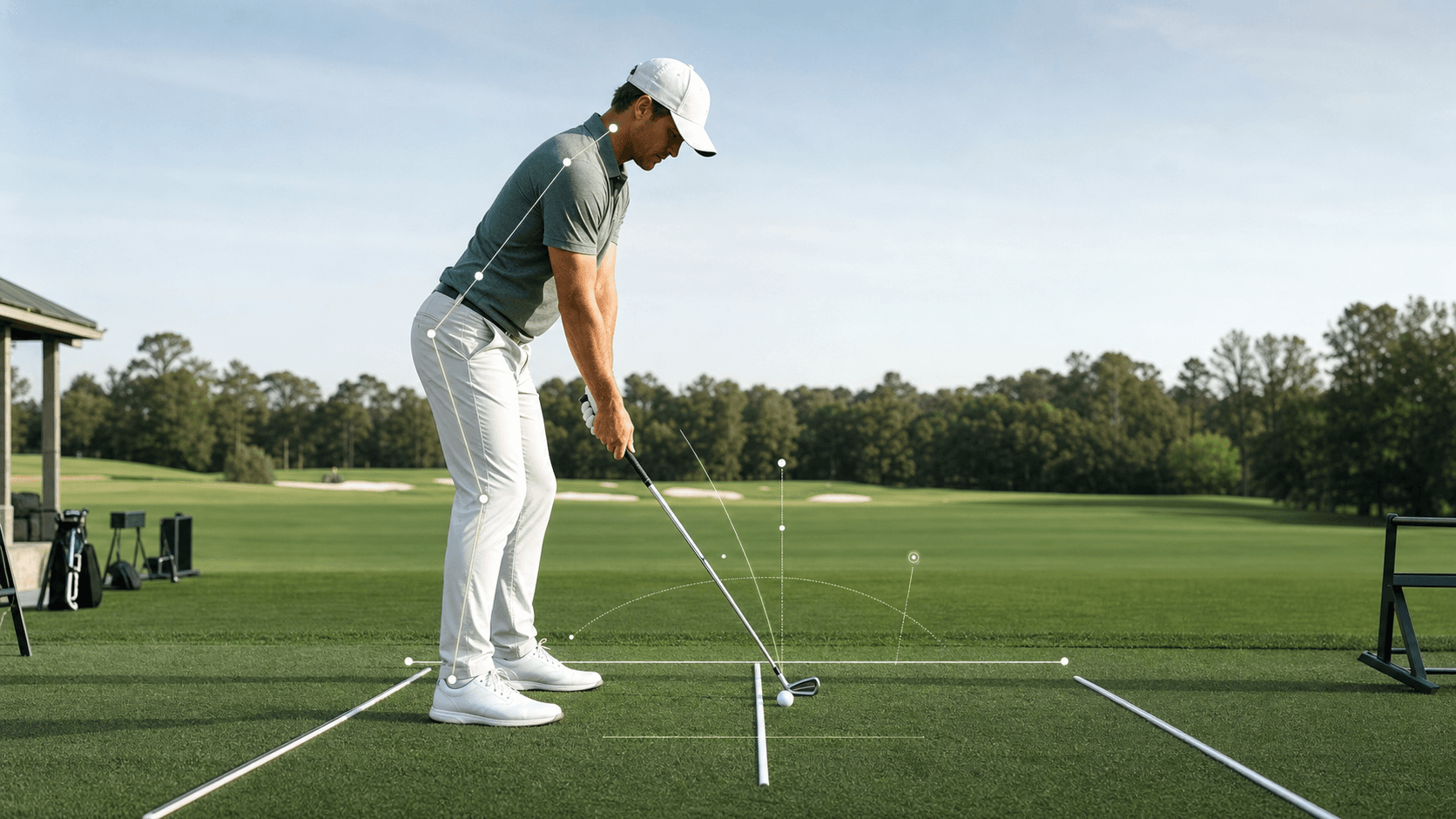
The Senior Golfer's Guide to Reclaiming Lost Yardage
Let's have a frank conversation. You step up to the tee, same hole you've played a hundred times. You take a good, honest swing, and the contact feels pure. But when you look up, the ball just doesn't have that same fire it used to. It lands in a spot you used to fly by without a second thought. Now, you're pulling out a long iron or a hybrid for your approach, while your buddies are hitting a wedge.
It's frustrating. It can make you feel like the game is leaving you behind.
But I'm here to tell you that it doesn't have to be that way. Losing distance is not an inevitable sentence for the senior golfer. It's a problem—a common one—but it's a problem with a solution. It's not about swinging harder or trying to recapture the swing of your 30-year-old self. It's about swinging *smarter*. It's about understanding how to generate effortless power with the body you have *today*.
This guide is your new playbook. We're going to keep it simple: one issue, one reason, one fix. We'll break down the most common distance-killers for senior golfers and give you practical, easy-to-implement solutions and drills to get those yards back.
So grab a cup of coffee, settle in, and let's get to work on finding that "hidden" power you still have in the tank.
Quick Answer: How Can Seniors Gain Distance in Golf?
For senior golfers to gain distance, the focus must shift from muscular effort to technical efficiency. The key is to maximize swing arc width, improve rotational turn (coiling), and perfect tempo and sequencing. This means turning your shoulders fully against a stable lower body, using the ground for leverage, and allowing the club to accelerate smoothly through impact. Upgrading to lighter, more flexible "senior" shafts can also provide an immediate and significant yardage boost.
Why Distance Can Change With Age
Before choosing an adjustment, consider a few age-related factors that can affect a golf swing. Individual changes vary, but mobility, power, and balance can influence how a player moves:
- Reduced Flexibility and Mobility: This is the big one. Tighter muscles in the back, hips, and shoulders make it harder to achieve a full, powerful turn. The body's natural response is to compensate, often by using the arms too much or swaying off the ball—both are certified distance killers.
- Loss of "Fast-Twitch" Muscle Fiber: The explosive power needed for high clubhead speed comes from fast-twitch muscles. Age-related changes can affect that capacity, so efficient movement and appropriately matched equipment may become more important.
- Decreased Balance: A stable base supports an efficient golf swing. When balance becomes less reliable, a golfer may shorten the swing or reduce rotational speed to stay stable.
The common thread is adaptation. The practical goal is to work with current mobility, strength, and balance while building an efficient, repeatable motion.
The 5 Pillars of Senior Golf Distance
Let's rebuild your power source, one pillar at a time. We'll focus on five key areas that will give you the most bang for your buck. For each one, we'll identify the common issue, explain the reason it's happening, provide a clear fix, and give you a simple thought or drill to work on.
Pillar 1: The Turn - It's a Coil, Not a Sway
The Issue: You slide your hips away from the target on the backswing (a sway) instead of rotating your torso around your spine (a turn).
The Reason: When flexibility is limited, a lateral sway *feels* like you're loading up for a big swing. It gives you a sensation of movement. However, this move is a massive power leak. When you sway, your center of gravity moves off the ball. From that position, it's nearly impossible to unwind powerfully and return the club to the ball with any speed or consistency. You spend your entire downswing just trying to get back to where you started.
The Fix: Learn to feel the difference between a turn and a sway. The goal is to create tension by coiling your upper body against a stable lower body. Think of a spring. You create energy by twisting it, not by sliding it from side to side.
The Drill: The Back-to-the-Wall Turn
- Stand without a club, your back against a solid wall, in your golf posture. Your rear end should be touching the wall.
- Cross your arms over your chest.
- Now, simulate your backswing by turning your shoulders.
- The Key: Your right hip (for a right-handed golfer) should stay in contact with the wall. If your right hip slides off the wall, you're swaying. If you turn correctly, you'll feel your left shoulder move down and across your body, and you'll feel tension building in your back and core. Your right hip will rotate back, but it will maintain its connection to the wall.
- Do this 10-15 times slowly to engrain the feeling of a pure rotation. This is the engine of your swing.
Pillar 2: The Arc - Width Equals Power
The Issue: Your hands and arms stay too close to your body during the backswing, creating a narrow, cramped swing arc.
The Reason: When flexibility is limited, a golfer may compensate by lifting the club with the arms and hands instead of turning the body. This can create a steep, narrow swing. Think about a child's merry-go-round. The person on the outside edge is moving much faster than the person near the center, even though they complete a circle in the same amount of time. The same principle applies to your golf swing. A wider arc gives the clubhead more time and distance to build up speed.
The Fix: Focus on extension. In the first part of your takeaway, feel as though you are pushing the clubhead straight back from the ball, keeping it low to the ground for as long as possible. Your goal is to create as much space as you can between your hands and your chest.
The Drill: The Headcover-Under-the-Arm Drill
- Take your normal setup.
- Place a driver headcover under your lead armpit (left armpit for a righty).
- Take slow, half-swings with a mid-iron.
- The Key: To keep the headcover from falling, you have to maintain the connection between your lead arm and your chest. This forces you to use your big muscles (your torso) to start the swing, which naturally creates width. If you just lift the club with your hands, the headcover will drop immediately.
- This drill promotes a "one-piece takeaway," which is the foundation of a wide, powerful swing arc.
Pillar 3: The Engine - Tempo is Your Best Friend
The Issue: You rush the transition from the top of the backswing to the downswing, trying to "muscle" the ball with your arms and shoulders.
The Reason: One common pattern is equating "fast" with "hard," then starting down abruptly with the upper body. A smoother transition may improve balance and contact, but test the cue rather than assuming it fits every golfer.
The Fix: Develop a smooth, unhurried rhythm. The best swings in the world look effortless because they have great tempo. Think of a pendulum on a grandfather clock—it's smooth, rhythmic, and it builds speed naturally at the bottom of its arc. Your swing should feel the same. A great swing thought is "slow and wide away, let it fall from the top."
The Drill: The Tempo Turn-and-Brush Drill
This is my favorite drill for seniors because it combines the feeling of a good turn with effortless tempo.
- Take a 7-iron and assume your normal setup, but without a ball.
- Start your backswing, focusing on the feelings from Pillar 1 (the coil) and Pillar 2 (the width).
- As you reach the top of your backswing, pause for a full second. Say "one-thousand-one" in your head. This feels unnatural at first, but it's crucial for killing the impulse to rush.
- From the top, simply let your arms fall and start your downswing by shifting your weight slightly to your lead foot. Don't pull. Don't heave. Just let gravity start the club down.
- Your only goal is to swing through and brush the grass at the bottom of your swing arc. Listen for that satisfying "swoosh" sound. The sound should be loudest *after* where the ball would be.
- Repeat this 10 times. Feel the rhythm. Back... pause... swoosh. This drill teaches your body that speed happens at the bottom, not at the top.
If you have trouble comparing feel with motion, start an AI conversation with Chubbs to describe the pattern or upload one clear swing for a visual checkpoint. For an expert eye, work with an independent qualified professional in person.
Pillar 4: The Fuel - Use the Ground
The Issue: Your lower body is passive and quiet during the swing, leading to an "all-arms" motion.
The Reason: Many senior golfers are (rightfully) concerned about balance. To stay stable, they often "lock" their lower body in place. While stability is good, a frozen lower body can't generate any power. The golf swing is a chain reaction. Power starts from the ground, travels up through your legs and core, and is finally transferred to the club. If you cut out the first link in that chain, you're leaving a massive amount of yardage on the table.
The Fix: Learn to use your feet and legs to initiate the downswing. Even a small, subtle shift and rotation of the hips before the arms start down can make a huge difference. You don't need a massive, PGA Tour-style hip rotation. You just need to feel your weight shift to your lead side and feel your lead hip start to clear out of the way.
The Drill: The Step-Through Drill
- Take a mid-iron and set up to an imaginary ball.
- As you start your backswing, allow your lead foot (left foot for a righty) to lift slightly off the ground and move next to your trail foot.
- To start the downswing, step your lead foot forward, back towards the target, planting it firmly.
- Let the rest of your body follow, swinging the club through to a full finish.
- This drill exaggerates the feeling of shifting your weight and using the ground to start the downswing. It forces your lower body to lead the way. After a few repetitions, go back to your normal swing and try to replicate that feeling of "pushing off" the ground with your trail foot to start the downswing.
Pillar 5: The Tools - Is Your Equipment Helping or Hurting?
The Issue: You're still playing with the same stiff-shafted, low-lofted driver you used 15 years ago.
The Reason: This is the lowest-hanging fruit on the distance tree. As your swing speed naturally decreases, the equipment you need changes dramatically. A shaft that is too stiff will not "kick" or bend properly at impact, robbing you of speed and causing the ball to fly lower and often to the right (for a righty). A driver with too little loft will produce a low, line-drive shot with very little carry.
The Fix: Get a simple equipment check-up. You don't need a full-blown, multi-thousand-dollar fitting. Just be honest about your current swing.
- Shaft Flex: Most senior golfers will benefit immensely from a "Senior" or "A-Flex" shaft. These shafts are lighter and more flexible, helping you generate more clubhead speed and get the ball in the air.
- Driver Loft: Forget the 8.5-degree drivers you see the pros use. A driver with 12, 13, or even 14 degrees of loft will be your best friend. The extra loft helps you launch the ball higher with the optimal amount of spin, maximizing carry distance. More carry means more total distance.
- Ball: Don't use the super-firm, high-compression balls the pros use (like a Pro V1x). Look for a softer, lower-compression golf ball. It will feel better off the clubface and will be easier for your moderate swing speed to compress, resulting in more distance.
People Also Ask (PAA)
Q1: What is a realistic driver distance for a 70-year-old golfer? A: Age alone does not determine a realistic driver distance. Fitness, mobility, technique, strike quality, equipment, and playing conditions all matter. Measure your current carry under consistent conditions, then track whether a change improves usable distance without sacrificing balance or contact.
Q2: How can a senior golfer increase swing speed? A: Seniors can increase swing speed not by swinging harder, but by swinging more efficiently. The keys are: 1) Creating a wider swing arc to give the club more time to accelerate. 2) Improving the "sequencing" of the downswing, so the lower body starts the motion, followed by the torso, then the arms. 3) Using a lighter, more flexible golf shaft that is properly matched to their tempo.
Q3: Is it better for seniors to have a flat or upright golf swing? A: Generally, a slightly flatter swing plane can be beneficial for senior golfers. As shoulder flexibility decreases, trying to force an upright, vertical swing can lead to strain and inefficient movements like swaying. A flatter, more rounded swing (think more like a baseball swing) relies more on body rotation, which is a more sustainable and powerful engine for many seniors.
Q4: What is the single most important golf tip for seniors to gain distance? A: If you could only focus on one thing, it would be tempo. A smooth, unhurried transition from the backswing to the downswing is the "secret sauce." Rushing from the top is the #1 distance killer for seniors. By learning to pause and let the club fall into the slot, you allow the swing sequence to happen correctly, creating effortless speed at the bottom of the arc where it matters most.
Putting It All Together: Your Path Forward
We've covered a lot of ground, but don't feel overwhelmed. You don't need to fix everything at once. The path to reclaiming your distance is a journey, not a sprint.
Start with one pillar. Go to the range and work only on that. Maybe for your first session, you just focus on the Tempo Turn-and-Brush Drill. Hit a whole bucket of balls just feeling that rhythm: back... pause... swoosh.
The next time, focus on width. Feel that great extension away from the ball.
The beauty of this game is that there's always something to work on. The frustration you're feeling now can be replaced by the satisfaction of a well-struck shot that sails past your expectations. You have the power in you. We just need to unlock it in a way that works for your body today.
If you want to accelerate your progress, seeing your swing is the best way to identify the biggest opportunity. For feedback grounded in your clip, upload a clear swing video for a video-informed Chubbs AI review; to add context, start an AI coaching conversation.
Bookmark this guide on golf tips for seniors to gain distance. Come back to it. Read one section before you head to the course. Little by little, you'll build a swing that's not just more powerful, but also more reliable, easier on your body, and a whole lot more fun.
Now, go get those yards back.
---