

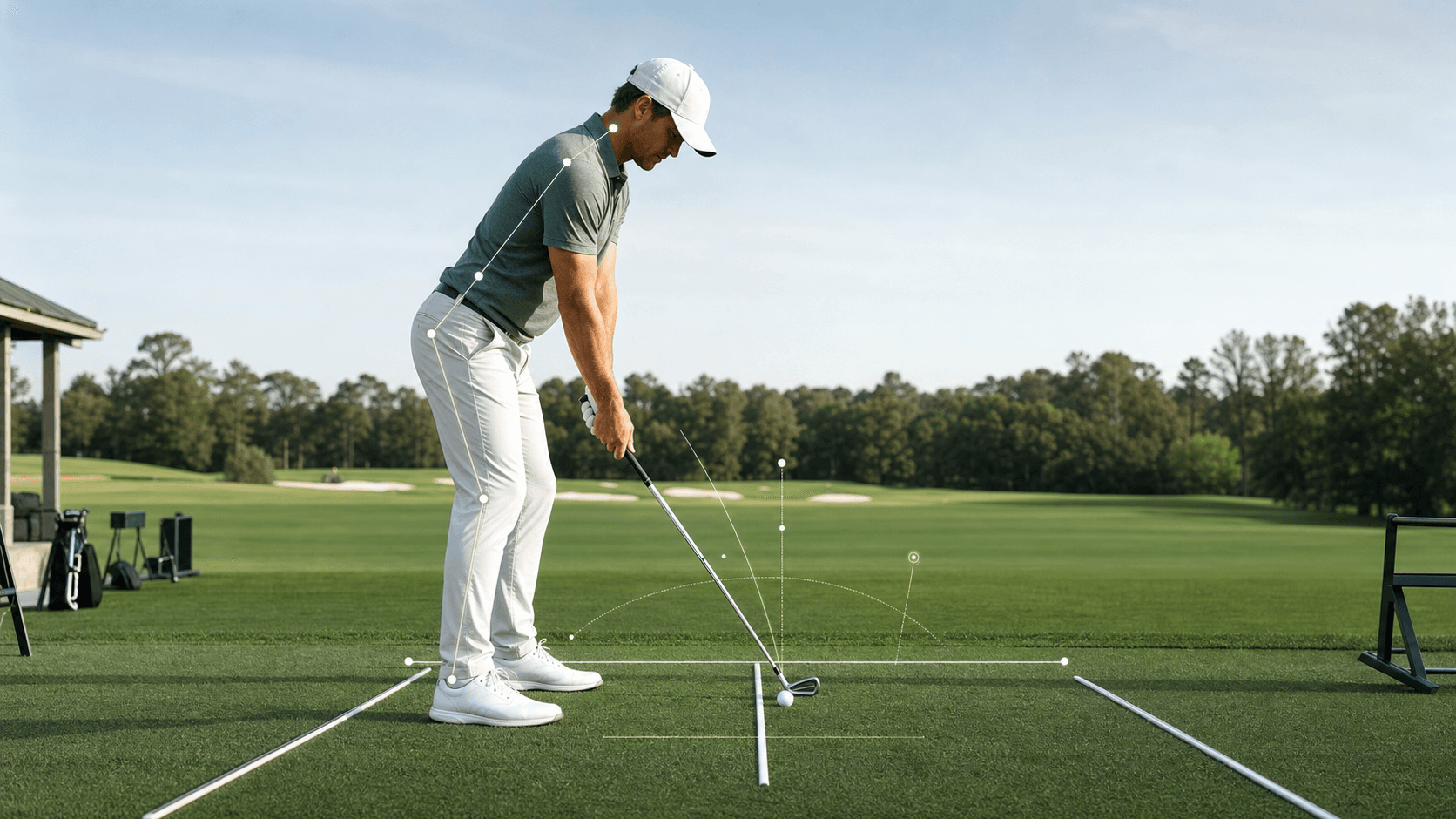
Chubbs is the Straight Line Golf Pro AI swing coach. This guide focuses on the takeaway, where a simple checkpoint can reduce unnecessary compensations later in the motion. The takeaway is the opening phase of the backswing and a useful place to build a simpler, more repeatable practice pattern.
Think of your golf swing as a journey. The takeaway is the first step out of the driveway. If you start in the wrong direction, you'll spend the rest of the trip trying to correct your course, often arriving late or off-target. A correct, simple takeaway sets you on the right path, allowing the rest of your swing to unfold naturally and efficiently, with fewer moving parts and less mental clutter. This article will guide you through understanding, implementing, and checking your takeaway to build a more straightforward and effective golf swing.
Quick Answer
The takeaway checkpoint for a simpler swing focuses on ensuring the club moves away from the ball as a single unit, avoiding immediate wrist hinge, excessive body rotation, or an off-plane path. At the point where the club shaft is parallel to the ground and your hands are roughly hip-high, the clubhead should be slightly outside your hands, and the clubface should generally mirror the angle of your spine at address. This position promotes a consistent swing plane, reduces the need for mid-swing corrections, and simplifies the entire motion, leading to more consistent ball striking.
Why the Takeaway Matters for Simplicity
The golf swing is a complex athletic motion, but its foundation is built on simple, repeatable movements. The takeaway is where these foundational movements begin. If your takeaway is out of sync, too fast, too far inside, or too far outside, it forces you to make adjustments later in the backswing, at the top, or even during the downswing. These adjustments are often difficult to time consistently, leading to varied contact, slices, hooks, and general frustration.
A simpler takeaway directly contributes to a simpler overall swing because it:
- Establishes the Correct Plane Early: Getting the club on the right path from the start means less effort is required to keep it there.
- Promotes Connection: When the arms, hands, and body move together, it fosters a sense of "one-piece" movement, which is inherently more stable and easier to repeat.
- Reduces Compensations: A good takeaway minimizes the need for complex manipulations later in the swing, freeing your mind to focus on the target and impact.
- Builds Consistency: Simple, repeatable movements are the bedrock of consistent ball striking. When your takeaway is consistent, the rest of your swing has a better chance of being consistent too.
Many weekend golfers struggle with inconsistency, and often, the root cause can be traced back to the initial move away from the ball. By focusing on this critical checkpoint, you can unlock a smoother, more powerful, and ultimately simpler swing.
Understanding the "Takeaway Checkpoint"
The takeaway checkpoint we're focusing on occurs when your club shaft is roughly parallel to the ground, and your hands are approximately at hip height. This is a crucial moment because it's the first significant position where deviations from an ideal path can be easily identified and corrected.
Here's what we're looking for at this checkpoint:
- Clubhead Position Relative to Hands: The clubhead should be just outside your hands. This indicates a proper arc and prevents the club from getting "stuck" too far inside or "loopy" too far outside.
- Shaft Angle and Target Line: The club shaft should be parallel to your target line. If it's pointing significantly inside or outside the target line, it suggests an off-plane takeaway.
- Clubface Angle: The clubface should generally mirror the angle of your spine at address, or be slightly closed (toe pointing slightly more towards the ground). This ensures the clubface is square to the path of your swing, preventing excessive opening or closing that would require compensation later.
When these three elements align at this checkpoint, you've successfully initiated a simple, on-plane takeaway. This sets a strong foundation for the remainder of your backswing, reducing the complexity of subsequent movements.
The Practical Checkpoint: "The Straight Line Check"
To make this practical, let's call our primary checkpoint "The Straight Line Check." This check helps you ensure your club is moving on a simple, efficient path right from the start.
How to Perform The Straight Line Check:
- Set Up: Address the ball as you normally would.
- Slow Takeaway: Make a very slow, deliberate takeaway until your club shaft is parallel to the ground and your hands are roughly hip-high.
- Observe (or Record):
- From Down-the-Line View: If you have a mirror or can record your swing from directly behind you (on the target line), observe the clubhead. Is it slightly outside your hands? Is the shaft parallel to your target line?
- From Face-On View: If you're using a mirror in front of you, you can check your clubface angle. Does it roughly match your spine angle, or is it slightly closed?
- Feel: Even without a mirror, try to *feel* this position. Does it feel connected? Does it feel like your arms and body moved together?
Why "The Straight Line Check" Promotes Simplicity:
This checkpoint is effective because it immediately flags common issues that complicate the swing:
- Club Too Far Inside: If the clubhead is behind your hands and the shaft points significantly inside the target line, you've likely rolled your wrists or over-rotated your body too early. This often leads to a "flat" backswing and a tendency to come over the top on the downswing.
- Club Too Far Outside: If the clubhead is significantly outside your hands and the shaft points outside the target line, you've likely lifted your arms or swung them away from your body too independently. This often leads to a "steep" backswing and a tendency to come too far inside on the downswing.
- Clubface Too Open/Closed: An excessively open clubface (toe pointing skyward) requires a lot of hand manipulation to square it at impact. An excessively closed clubface (toe pointing too far down) can lead to hooks.
By ensuring these three elements are correct at "The Straight Line Check," you establish a neutral, on-plane path that minimizes the need for complex compensations later.
Common Issues and Their Impact on Simplicity
Let's look at a few common takeaway issues and how they complicate your swing. For each, we'll identify a likely reason and a simple fix.
Issue 1: Taking the Club Too Far Inside
This is a very common fault. The clubhead quickly moves behind your hands and inside the target line.
- Likely Reason: Often, this comes from an early wrist roll or an over-eagerness to rotate the body without moving the club and arms together. It can also stem from a misunderstanding of how the club should move on an arc.
- Impact on Simplicity: An inside takeaway often leads to a "flat" backswing. From this position, golfers frequently lift their arms at the top, creating a steep angle on the downswing, leading to slices or pulls. It forces a complex rerouting of the club on the downswing.
- Simple Fix: Focus on moving the clubhead, hands, and arms away from the ball as a single unit, using your shoulder turn. Imagine a wide arc, keeping the clubhead outside your hands for as long as possible in the initial movement.
Issue 2: Taking the Club Too Far Outside
Less common, but still problematic, is moving the clubhead directly away from the target or even slightly outside the target line.
- Likely Reason: This often occurs when the arms dominate the takeaway, disconnecting from the body turn. It can also be an attempt to "keep the club outside" or avoid an inside takeaway, but taken to an extreme.
- Impact on Simplicity: An outside takeaway typically leads to a "steep" backswing. From here, golfers often drop the club too far inside on the downswing, leading to blocks or pushes, or they maintain the steepness, resulting in pulls or slices. It complicates the transition and requires significant compensation.
- Simple Fix: Emphasize the connection between your arms and chest. Feel your lead shoulder turning away from the ball, pulling the club with it, rather than pushing the club away with your hands.
Issue 3: Lifting or Rolling the Club Early
This involves either immediately hinging the wrists upwards or excessively rolling them open or closed right at the start.
- Likely Reason: This is often a result of using too much hand and wrist action early, rather than initiating the swing with the larger muscles of the shoulders and core. It can also be a habit developed from trying to generate speed too early.
- Impact on Simplicity: Early lifting or rolling immediately takes the club off plane and creates unnecessary moving parts. It makes it harder to control the clubface and requires precise timing to square it at impact, reducing consistency.
- Simple Fix: Maintain the triangle formed by your arms and shoulders for the first foot or so of the takeaway. Feel as though your chest is moving the club away, keeping your wrists relatively passive until the club reaches hip height.
The Named Drill/Test: "The One-Piece Takeaway Drill"
This drill is designed to instill the feeling of a connected, simple takeaway that passes "The Straight Line Check."
How to Perform "The One-Piece Takeaway Drill":
- Set Up: Address a ball (or an imaginary ball) as usual.
- Alignment Stick (Optional but Recommended): Place an alignment stick or another club on the ground, parallel to your target line, about 6-12 inches outside your clubhead at address. This provides a visual boundary.
- Focus on Connection: Without hinging your wrists, slowly take the club away from the ball. Your goal is to feel your shoulders, arms, and clubhead move back together as a single unit.
- Trace the Arc: As you move back, visualize the clubhead moving slightly inside the alignment stick, but still outside your hands. The clubface should remain relatively square to your body's rotation, generally mirroring your spine angle.
- Stop at the Checkpoint: Stop when your club shaft is parallel to the ground and your hands are at hip height.
- Verify: Check your position against "The Straight Line Check":
- Clubhead slightly outside hands?
- Shaft parallel to target line?
- Clubface angle roughly matching spine angle?
- Repeat: Return to address and repeat the slow motion takeaway multiple times, focusing on the *feel* of the connected movement and hitting the checkpoint correctly.
Why This Drill Promotes Simplicity:
"The One-Piece Takeaway Drill" forces you to use your larger muscles (shoulders and core) to initiate the swing, rather than relying on small, inconsistent hand and wrist movements. By focusing on a slow, connected movement to the checkpoint, you build muscle memory for an efficient, on-plane start. The alignment stick helps provide immediate feedback on your path, guiding you to avoid taking the club too far inside or outside.
Practice the drill until the checkpoint feels repeatable. You can upload one clear swing for a video-informed Chubbs AI checkpoint, but it is not an expert human review or exact measurement.
Integrating the Takeaway Checkpoint into Your Practice
Mastering the takeaway checkpoint isn't about perfection in every swing; it's about building a consistent foundation. Here's how to integrate it effectively:
- Start Slow: Always begin your practice with slow-motion takeaways, focusing solely on hitting "The Straight Line Check" correctly. Don't worry about hitting a ball initially.
- Use Visual Aids: Utilize mirrors, phone cameras, or alignment sticks to get immediate feedback.
- Feel vs. Real: What feels right isn't always what's actually happening. Use visual feedback to calibrate your feel. Once you know what a good takeaway *looks* like, you can start to associate that with a specific *feel*.
- Repetition: Consistent, mindful repetition of "The One-Piece Takeaway Drill" is key.
- Progress Gradually: Once you're consistently hitting the checkpoint in slow motion, gradually increase your speed, still focusing on maintaining the correct initial movement.
- Don't Overthink on the Course: In competition or on the course, trust your practice. Focus on a simple swing thought, like "connected takeaway," rather than trying to hit a precise position. The goal is to make it automatic.
Benefits of a Simpler Takeaway
By dedicating time to understanding and refining your takeaway checkpoint, you'll experience several tangible benefits that contribute to a more enjoyable and effective golf game:
- Increased Consistency: Fewer compensations mean more repeatable swings and more consistent ball striking.
- Improved Contact: A club that's on plane from the start is more likely to return to the ball squarely, leading to better contact and more solid shots.
- Reduced Slice/Hook Tendencies: A neutral takeaway helps control the clubface and path, reducing wild shots.
- Greater Power Potential: When the swing is efficient, energy is transferred more effectively to the ball, leading to potentially greater distance without extra effort.
- Less Mental Clutter: A simpler swing means less to think about, allowing you to focus on target and execution.
- Enhanced Enjoyment: When you hit the ball more consistently and effectively, the game becomes far more rewarding.
If you are struggling to implement the change, start a Chubbs AI conversation with the miss, club, goal, and feel, or upload one clear swing for a video-informed checkpoint.
Quick Checklist
- Address: Set up squarely and comfortably.
- Slow Takeaway: Initiate the backswing slowly, focusing on connection.
- Checkpoint Position: Stop when the club shaft is parallel to the ground and hands are hip-high.
- Clubhead Check: Is the clubhead slightly outside your hands?
- Shaft Check: Is the shaft parallel to the target line?
- Clubface Check: Does the clubface angle roughly match your spine angle, or is it slightly closed?
- One-Piece Feel: Does it feel like your shoulders, arms, and club moved together?
- Drill Practice: Regularly perform "The One-Piece Takeaway Drill."
- Gradual Speed: Increase speed only after consistency at slow motion.
FAQ
Q: How far back should I check my takeaway? A: The primary checkpoint discussed here is when your club shaft is parallel to the ground and your hands are roughly at hip height. This is the first critical position to verify.
Q: Does this takeaway checkpoint apply to all clubs? A: Yes, the fundamental principles of a connected, on-plane takeaway apply to all clubs, from your driver to your wedges. The length and arc of the swing will vary, but the initial movement away from the ball should maintain these core elements of simplicity and connection.
Q: What if my clubface is wide open or closed at the checkpoint? A: If your clubface is wide open (toe pointing straight up), you're likely rolling your wrists excessively or disconnecting your arms. If it's too closed (toe pointing too far down), you might be shutting the clubface with your hands. Focus on maintaining the relationship between your lead arm and the clubface, and ensure your body rotation is driving the club, not just your hands.
Q: How often should I practice this checkpoint? A: Incorporate "The One-Piece Takeaway Drill" into the beginning of every practice session. A few minutes of focused, slow-motion repetitions can make a significant difference in reinforcing the correct movement. Even a few practice swings before a round, focusing on this checkpoint, can help set a good tone.
Q: Will a simpler takeaway reduce my power? A: No, quite the opposite. An efficient, simpler takeaway reduces wasted motion and helps you get the club into a powerful position at the top of your backswing. This allows for a more direct and powerful transition into the downswing, often leading to *more* consistent power, not less. Power comes from efficiency and proper sequencing, not from frantic, disconnected movements.
Conclusion
The takeaway checkpoint for a simpler swing is not just a technical detail; it's a foundational principle for building a more consistent and enjoyable golf game. By understanding what a good takeaway looks and feels like, and by diligently practicing "The One-Piece Takeaway Drill," you can eliminate many common swing faults before they even begin. Remember, a simple start leads to a simpler journey, and in golf, a simpler journey often leads to better results. Focus on this critical first step, and watch as the rest of your swing falls into place with greater ease and consistency.