

As a senior golfer, the desire to maintain or even regain distance is a common and understandable goal. Many believe the only path to more yardage is to swing harder, but this often leads to a loss of control, increased effort, and sometimes even discomfort. At Straight Line Golf Pro, we understand that true distance comes from efficiency, not brute force. This article outlines a practical, calm approach to help you achieve a senior golfer distance plan without swinging harder, focusing on fundamental movements that unlock your club's potential.
Our approach centers on maximizing what you already have: your body's natural rotation, balance, and the club's design. By refining your technique, you can generate more clubhead speed at impact with less perceived effort, translating directly into more yards down the fairway. This isn't about chasing a mythical power swing; it's about making your current swing more effective.
Quick Answer
To gain distance without swinging harder, a senior golfer should focus on three core areas: building a stable, balanced foundation, optimizing efficient body rotation, and achieving consistent, centered clubface contact. By ensuring your setup promotes stability, your body turns effectively around a central axis, and your club meets the ball squarely, you can significantly increase ball speed and carry distance with the same or even less physical effort. This plan emphasizes mechanics over muscle.
The Foundation: Stability and Balance
Many golfers, especially as they age, tend to lose distance because their swing lacks a stable foundation. Without a solid base, the body struggles to generate and transfer power efficiently, leading to compensatory movements that rob you of yardage.
The Issue: An unstable setup or a sway during the backswing and downswing. This often manifests as feeling "off balance" or having to recover your footing during or after the swing.
The Reason: Trying to generate power by shifting too much weight laterally instead of rotating around a stable center. This can also stem from a fear of falling, leading to restricted rotation or an over-reliance on arm action. When the body sways, it becomes difficult to return the club to the same precise impact position consistently. This inconsistency leads to off-center strikes and reduced clubhead speed at impact.
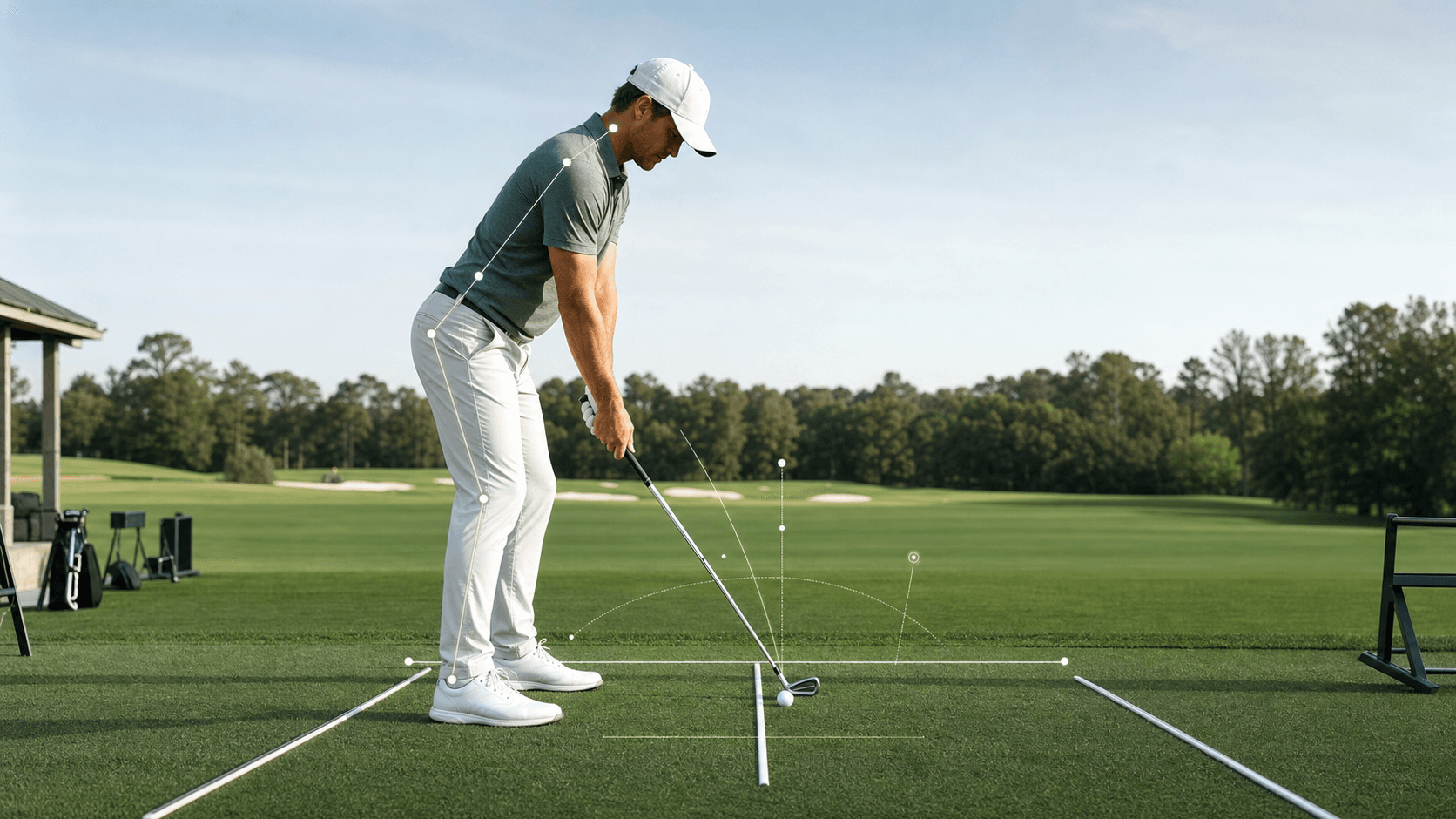
The Fix: Establish a wider, more athletic stance with a focus on feeling grounded. Your weight should be evenly distributed, with a slight flex in your knees, and your hips positioned directly over your ankles. Imagine your feet are "rooted" to the ground. This stable base allows your body to rotate around a central axis without unnecessary lateral movement.
Practical Checkpoint: The Static Balance Check
Before every swing, perform this quick check:
- Setup: Take your normal address position with a club.
- Feel Your Feet: Focus on the pressure points in your feet. You should feel balanced, not leaning too much on your heels or toes, and not favoring one side.
- Wiggle Test: Gently try to wiggle your toes inside your shoes without losing your balance. If you can, it suggests your weight is slightly more towards your mid-foot/heels, which is good for stability. If you can't, you might be too far forward on your toes, which can lead to instability.
- Confirm Stability: Once you feel stable and balanced, maintain that feeling throughout your backswing and downswing. The goal is to rotate *around* this stable base, not move off it.
This checkpoint helps ingrain the feeling of a solid foundation, which is crucial for efficient power generation.
The Engine: Efficient Body Rotation
Once you have a stable base, the next step is to use your body's natural rotational power effectively. Many senior golfers inadvertently restrict their body turn, relying too much on their arms and hands to power the swing. This "armsy" swing is less powerful and more fatiguing.
The Issue: An insufficient hip and shoulder turn in the backswing, or a disconnect between the upper and lower body during the downswing. This often results in a shorter backswing arc and a feeling of "hitting at" the ball rather than "swinging through" it.
The Reason: A common misconception is that a big arm swing equals more power. In reality, the power in a golf swing primarily comes from the rotation of your larger muscle groups (hips, torso, shoulders) around a stable spine. When the body doesn't turn enough, the arms are forced to compensate, leading to a loss of lag, casting, and a significant reduction in clubhead speed at impact. Flexibility can be a factor, but even with reduced flexibility, maximizing the turn you *do* have is key.
The Fix: Focus on making a full, uninhibited turn of your hips and shoulders in the backswing, allowing your arms to follow naturally. Think of your spine as a central axis around which your body rotates. Your lead shoulder should turn behind the ball, and your trail hip should rotate back and slightly up. In the downswing, initiate the movement with your lower body, allowing your hips to lead the rotation, pulling your upper body and arms through. This sequence creates a powerful chain reaction.
Named Drill: The Straight Line Hip Turn Drill
This drill emphasizes proper body rotation without over-swinging or swaying.
- Setup: Stand in your normal golf posture, but without a club. Place a golf alignment stick or a broom handle across your chest, holding it with both hands against your shoulders.
- Find Your Axis: Imagine a straight line running from the top of your head down to the ground between your feet – this is your central axis.
- Backswing Turn: From your stable setup, slowly rotate your upper body as far as comfortable, keeping your head relatively still over your imagined axis. Feel your lead shoulder turn *behind* the ball position and your trail hip rotate *back*. The goal is to feel the stretch and coil in your core, not a lateral shift. The alignment stick should point roughly at the ball or slightly inside it at the top of your backswing.
- Downswing Turn: Initiate the downswing by rotating your hips towards the target. Feel your trail hip drive forward and around, followed by your torso and shoulders. The alignment stick should rotate through to point at the target.
- Maintain Stability: Throughout the drill, ensure your feet remain grounded and you don't sway off your central axis. The movement is rotational, not lateral.
- Practice: Perform this drill slowly and deliberately 10-15 times before hitting balls. Focus on the feeling of coiling and uncoiling around your stable base.
This drill helps train the feeling of a powerful, rotational swing that generates speed from your core, reducing the need to swing harder with your arms.
The Connection: Arm-Body Synchronization
A common cause of lost distance for senior golfers is a lack of synchronization between the arms and the body, particularly in the downswing. When the arms outrace the body, it leads to a loss of lag and an "over-the-top" or "casting" motion, which significantly reduces clubhead speed at impact.
The Issue: The arms and hands dominate the downswing, often starting the forward motion too early. This "casting" releases the club's stored energy prematurely, leading to a shallow angle of attack and a weak impact.
The Reason: This often stems from an unconscious desire to "hit" the ball rather than "swing through" it. When the body doesn't lead the downswing, the arms are left to do all the work, losing the powerful leverage created by a proper sequence. It's like throwing a punch with just your arm instead of turning your body into it.
The Fix: Focus on allowing your lower body and core rotation to initiate the downswing. Your arms should feel like they are "along for the ride" initially, maintaining their connection to your turning torso. This creates a natural "lag" where the clubhead trails the hands until the very last moment before impact. This delayed release allows for maximum clubhead speed through the hitting zone. Think of it as pulling the club with your body, rather than pushing it with your arms.
The Impact: Consistent Contact and Clubface Control
Even with a perfect swing, if you don't strike the ball consistently in the center of the clubface with a square clubface, you're leaving significant distance on the table. The "smash factor" (ball speed divided by clubhead speed) is dramatically affected by off-center hits.
The Issue: Frequent off-center hits (toe, heel, thin, fat) and/or an open or closed clubface at impact. These issues lead to reduced ball speed, unwanted spin, and directional errors.
The Reason: Often, inconsistent contact is a symptom of the earlier issues: an unstable base, poor body rotation, or a lack of arm-body synchronization. When the body is out of sync, it's incredibly difficult to consistently return the club to the precise impact position required for solid contact. Additionally, a lack of awareness of the clubface angle throughout the swing can contribute to directional issues.
The Fix: Prioritize striking the ball squarely in the center of the clubface. This requires maintaining your posture through impact and ensuring your body's rotation brings the club to the ball on the correct path. For clubface control, focus on keeping the clubface square to your target line at impact. This is a feeling of the clubface "looking" at the target as it passes through the ball.
If contact is inconsistent, use impact tape or foot spray to locate the strike. You may also upload one clear swing at `/upload` for a video-informed Chubbs AI checkpoint, but the AI cannot measure the impact position or establish what caused an off-center strike.
Leveraging Technology and Equipment
While technique is paramount, modern golf equipment can certainly assist in gaining distance without swinging harder.
- Club Fitting: A professional club fitting can ensure your clubs (especially your driver) are optimized for your swing speed, tempo, and physical capabilities. Lighter shafts, higher lofts, and more forgiving clubhead designs can all contribute to more ball speed and higher launch, which translates to more carry distance.
- Ball Choice: Softer, lower-compression golf balls can often feel better for senior golfers and may offer a slight distance advantage at moderate swing speeds due to increased ball speed off the face.
- SLGP AI support: Upload a clear swing video for a video-informed Chubbs review, or start an AI coaching conversation to describe your mobility, goals, and current miss. Treat the response as a practice starting point, not an exact measurement or medical assessment.
Practice Strategy for Sustainable Distance
Gaining distance without swinging harder is a process that requires focused practice, not just hitting a bucket of balls as hard as you can.
- Quality Over Quantity: Focus on fewer, more deliberate swings, emphasizing the feelings of stability, rotation, and connection.
- Slow Motion Drills: Practice the Straight Line Hip Turn Drill and other rotational movements in slow motion to ingrain the correct sequencing and body awareness.
- Impact Focus: Use impact tape or foot spray on your clubface to monitor your contact point. This immediate feedback is invaluable for improving consistency.
- Tempo and Rhythm: Work on maintaining a smooth, unhurried tempo throughout your swing. A controlled, rhythmic swing is often more powerful than a fast, jerky one.
- Listen to Your Body: If you experience any pain, stop and consult a healthcare professional. This plan is about efficiency and comfort, not pushing your body beyond its limits.
By committing to these fundamental principles and a smart practice routine, you will find that more distance is not only achievable but also sustainable and enjoyable. The goal is to make your swing work smarter, not harder.
Quick Checklist
- Stable Setup: Are your feet wide, knees flexed, and weight balanced? (Perform Static Balance Check)
- Full Rotation: Are your hips and shoulders turning around a stable spine in the backswing? (Practice Straight Line Hip Turn Drill)
- Body-Led Downswing: Is your lower body initiating the downswing, pulling your arms through?
- Connected Arms: Do your arms feel connected to your torso, avoiding an early release?
- Centered Contact: Are you consistently striking the ball in the center of the clubface? (Use impact feedback)
- Square Clubface: Is your clubface square to the target at impact?
- Smooth Tempo: Is your swing smooth and rhythmic, not rushed?
FAQ
Q: Will focusing on technique really give me more distance than just trying to swing harder? A: Absolutely. Swinging harder often leads to a loss of control, off-center hits, and inefficient energy transfer. Focusing on technique, especially stability, rotation, and consistent contact, allows you to maximize the clubhead speed you *do* generate and transfer that energy more effectively to the ball, resulting in greater distance with less effort.
Q: I have limited flexibility. Can I still gain distance without swinging harder? A: Yes. While flexibility helps, the key is to maximize the rotation you *do* have around a stable axis. Even a slightly shorter but more efficient turn will generate more power than a long, uncontrolled arm swing. Focus on core stability and the quality of your turn, not just the quantity.
Q: How quickly can I expect to see results with this plan? A: Improvement varies for everyone. Some golfers notice immediate changes in consistency and feel, while significant distance gains might take several weeks or months of consistent practice. The key is patience and focusing on the process, not just the outcome.
Q: Should I change my equipment to help with distance? A: Equipment can certainly help, but it's secondary to technique. A proper club fitting can optimize your driver's loft, shaft flex, and weight for your specific swing, potentially adding yards. However, even the best equipment won't compensate for fundamental swing flaws. Address your technique first, then consider equipment adjustments.
Q: How can SLGP help me with this distance plan? A: Use `/upload` for one video-informed Chubbs AI review that flags a visible priority, or `/coach` to add your mobility, miss, club, and goal. Chubbs cannot measure speed, mobility, or distance and does not replace medical advice or in-person instruction.