

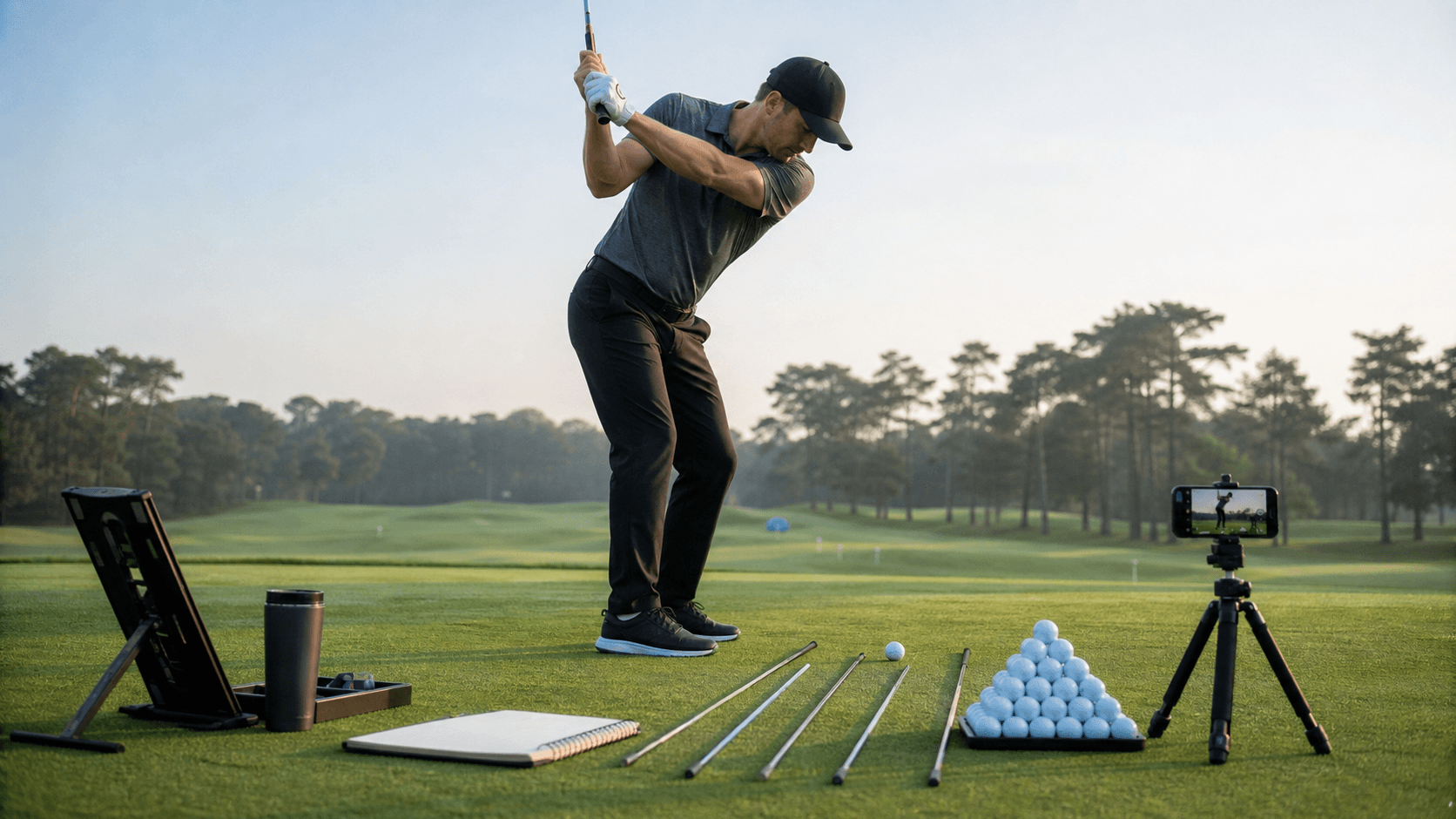
Golfers searching for pull slice pre shot routine usually do not need a louder swing thought. They need one clean checkpoint, one useful drill, and a way to tell whether the next ball was better for the right reason. Chubbs keeps this topic inside the Slice Correction lane so the advice stays practical for a Busy weekend golfer, not a tour-level rebuild.
The pattern to watch is simple: the face is open to the path and the ball is curving away from the target. That does not mean every golfer has the same cause. It means the first job is to collect better evidence before adding more mechanics. One issue. One reason. One fix. One drill.
Quick Answer
For pull slice pre shot routine, start with this checkpoint: start with the clubface aimed first, then match the feet and shoulders to that face. Then use the Start-Line Gate Drill and measure three balls that start through the gate before judging curve. If the pattern improves, keep the cue. If it does not, stop guessing and bring clearer evidence to Chubbs through /upload or work through the pattern in /coach.
Do not judge the change by one swing. Judge the next small set. Golf has noise, and a useful practice plan protects you from chasing every miss.
What This Fix Is Really About
Pull slice pre shot routine sits in the same family as slice correction, pull slice, pre shot routine, golf drill. The common thread is not a magic move. The common thread is matching what the ball did to a checkpoint the golfer can actually repeat.
If the ball starts offline, check the face and aim first. If the ball starts on line and curves, check the face-to-path relationship. If contact is the problem, check low point, strike location, posture, and balance before adding speed. For this article, Chubbs narrows the work to slice so the golfer has one job instead of five.
Use Chubbs one-flaw rule: explain pull slice in plain English, give one fix, one drill, and encouragement; avoid dumping five mechanics at once. The right answer should feel boring enough to repeat. That is the point.
The One Checkpoint
Use this as the session checkpoint: start with the clubface aimed first, then match the feet and shoulders to that face. Make it visible. If a friend, phone camera, alignment stick, tee, towel, or headcover can confirm the checkpoint, use it. If the checkpoint only exists as a feeling, it is too easy to fool yourself.
Before the first ball, rehearse the checkpoint twice. After the ball, write down only four facts: start line, curve, contact, and finish balance. Those four facts tell Chubbs more than a paragraph of swing feelings.
The Drill: Start-Line Gate Drill
Run the drill in a short set. The goal is not to hit a perfect shot. The goal is to see whether the checkpoint changes the average pattern.
- Make one slow rehearsal with the checkpoint exaggerated.
- Hit one ball at about seventy percent speed.
- Hold the finish long enough to notice balance and contact.
- Record the result in plain language.
- Repeat until you have at least six measured shots.
Your pass/fail measure is this: three balls that start through the gate before judging curve. When the drill passes, do not add another fix. Hit a few normal shots with the same cue and see whether the pattern survives.
Common Mistakes
The first mistake is aiming farther left and making the slice pattern bigger. The second mistake is judging the drill after one ball. One ball can lie. A six-ball set tells a better story.
The third mistake is mixing goals. If today is about pull slice pre shot routine, do not also rebuild grip, tempo, posture, and shot shape unless the evidence clearly points there. Chubbs works better when the golfer brings a narrow question and a clean pattern.
The fourth mistake is making the drill too fast too soon. Half speed is not a punishment. It is where the body learns the order of the motion before full speed tests it.
Practice Plan
Use a twenty-minute session.
- Five minutes: rehearse the checkpoint with no ball.
- Ten minutes: run the Start-Line Gate Drill and track each result.
- Three minutes: hit normal shots with the same cue.
- Two minutes: write the pattern in one sentence.
A good note sounds like this: “With pull slice pre shot routine, the ball mostly did this, the checkpoint felt like this, and the best result came when I stayed with one cue.” That note is useful. “My swing is broken” is not useful.
Taking It to the Course
On the course, shrink the work to one phrase: pick a conservative left edge only after the face is aimed square. The range can handle rehearsals and checkpoints. The course needs a target, a committed swing, and acceptance of the safe miss.
For informational intent and TOFU stage, the next step is not more information for its own sake. The next step is a cleaner decision. If the same miss appears twice, choose a wider target, keep the cue simple, and make the next swing playable.
When to Use Chubbs AI Feedback
Use Chubbs when the same pattern survives two focused sessions, when the ball flight and contact disagree, or when you cannot tell which checkpoint matters. The best upload includes one clear down-the-line or face-on clip no longer than 15 seconds. Add the club used, usual miss, and drill you tried in the Chubbs conversation. Chubbs can then respond with one issue, one reason, one fix, and one drill instead of a mechanical checklist.
If the same miss shows up again, record one down-the-line clip and upload it for a video-informed AI review. If you would rather describe the pattern first, start an AI coaching conversation with Chubbs.
Quick Checklist
- Name the ball flight and contact pattern before changing the swing.
- Use the checkpoint: start with the clubface aimed first, then match the feet and shoulders to that face.
- Run the Start-Line Gate Drill in a measured six-ball set.
- Track start line, curve, contact, and finish balance.
- Avoid the common trap: aiming farther left and making the slice pattern bigger.
- Take only one cue to the course.
- Ask Chubbs for help if the same pattern survives two sessions.
FAQ
How long should I practice pull slice pre shot routine before judging it?
Give it two short sessions. One session can be random. Two sessions with the same checkpoint usually show whether the pattern is moving.
Should I think about this during a round?
Use only the course cue: pick a conservative left edge only after the face is aimed square. Keep the detailed rehearsal on the range.
What if the drill makes the ball worse?
Slow down and check whether the drill matches the real miss. If the same miss keeps showing up, record the swing and ask Chubbs for a narrower checkpoint through /upload or /coach.