

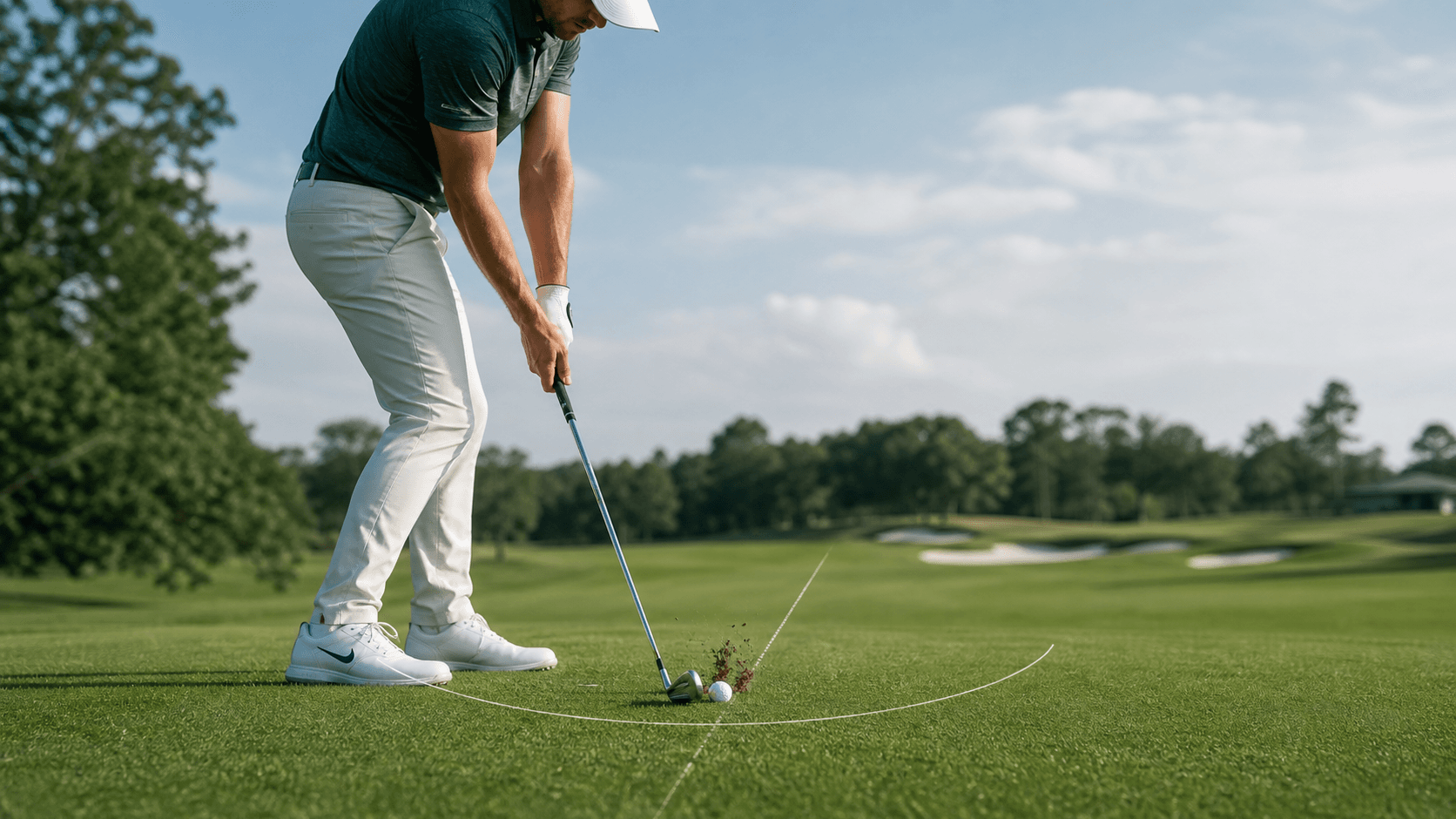
Chubbs is the Straight Line Golf Pro AI swing coach. This guide focuses on an often-overlooked part of iron distance: setup. Many golfers concentrate on the motion itself, but ball position, posture, alignment, and grip pressure shape the strike before the club moves. A sound setup gives the swing a more reliable foundation.
When we discuss "distance" with irons, we're not just talking about hitting the ball further for the sake of it. We're talking about optimizing the energy transfer from your body to the club, and from the club to the ball. This means solid contact, proper launch, and minimal sidespin. A flawed setup can introduce compensations into your swing, leading to inconsistent strikes, reduced clubhead speed, and a significant loss of yardage. It's about getting the most out of every swing, every time.
The sections below address common setup mistakes that may cost distance and pair each one with a calm, practical correction to test.
Quick Answer
Many golfers lose iron distance due to common setup errors that hinder solid contact and efficient power transfer. The primary culprits often include incorrect ball position for irons, leading to fat or thin shots; poor posture and spine angle, which restrict rotation and power; misaligned shoulders and hips, forcing compensation and glancing blows; and excessive grip pressure, which reduces clubhead speed and feel. Correcting these setup elements – specifically, placing the ball slightly forward of center, maintaining an athletic posture, squaring your body to the target, and using a light, firm grip – can significantly improve your strike quality and restore lost distance.
The Foundation of Distance: Why Setup Matters
Think of your setup as the launchpad for your swing. Every element – from how you stand, to where the ball is positioned, to how you hold the club – dictates the potential of your golf swing. A correct setup allows your body to move freely and powerfully, promoting a consistent swing path and a square clubface at impact. When your setup is off, your body often has to make subconscious adjustments during the swing to compensate. These compensations are rarely efficient. They can lead to:
- Inconsistent Contact: Hitting the ball thin, fat, or off the heel/toe. Poor contact is the ultimate distance killer.
- Reduced Clubhead Speed: Tension or an inefficient body position can prevent you from generating maximum speed.
- Improper Angle of Attack: For irons, we generally want a slightly descending blow to compress the ball. An incorrect setup can lead to a shallow or overly steep attack, both of which reduce distance.
- Loss of Compression: Solid contact, where the ball is "compressed" against the clubface, is crucial for maximizing ball speed and distance. A poor setup makes this difficult to achieve.
Let's break down the specific setup mistakes that often lead to these issues.
Common Setup Mistakes That Steal Your Iron Distance
Mistake 1: Incorrect Ball Position for Irons
The Issue: One of the most frequent setup errors I observe is placing the ball in the wrong spot relative to your stance for an iron shot. Some golfers play it too far forward, as if it were a driver, while others place it too far back, almost off their trail foot.
The Reason: Your ball position directly influences the low point of your swing arc and your angle of attack. For irons, we want to hit the ball slightly *before* the absolute low point of the swing, taking a shallow divot *after* the ball. This promotes a slightly descending blow, which is ideal for compressing the ball and achieving proper launch and spin.
- If the ball is too far forward, you're likely to hit up on it, leading to thin shots, reduced compression, or even topping the ball. This "scooping" motion robs you of power and often adds unwanted spin.
- If the ball is too far back, you might hit down too steeply, resulting in fat shots where you hit the ground before the ball, or you might "smother" the ball, reducing its launch and distance.
The Fix: For most mid-irons (like a 7-iron), the ball should be positioned roughly in the center of your stance, or perhaps just one ball-width forward of center. As you move to longer irons (5-iron, 4-iron), the ball can move slightly more forward, but never as far forward as a driver. For short irons (pitching wedge, 9-iron), it's often directly in the center or even a touch back of center.
Impact on Distance: Correct ball position ensures you strike the ball with a slightly descending blow, maximizing compression and ball speed. An incorrect position leads to glancing blows, fat shots, or thin shots, all of which drastically reduce the energy transferred to the ball, costing you significant yardage.
Mistake 2: Poor Posture and Spine Angle
The Issue: Many golfers adopt a posture that is either too hunched over or too upright at address. This often comes from bending too much at the waist without enough knee flex, or vice-versa, losing the athletic "ready" position.
The Reason: Your posture and spine angle are critical for maintaining balance, allowing for a full and free rotation during the swing, and setting your swing plane.
- A hunched posture restricts your shoulder and hip turn, forcing an arm-dominated swing. This reduces power and makes it harder to maintain balance. It can also lead to a flatter swing plane, encouraging fat shots.
- An overly upright posture can cause you to stand too close to the ball, leading to a cramped swing, or too far away, leading to reaching. It can also encourage a more upright swing plane, potentially causing thin shots or pulls.
The Fix: Achieve an athletic posture by standing tall, then bending forward from your hips (not your waist) until your arms hang naturally below your shoulders. Add a slight flex to your knees. Your weight should feel balanced over the balls of your feet, not on your heels or toes. Your spine should have a slight tilt away from the target, especially with longer irons. Imagine you're about to jump – that's the athletic readiness we're looking for.
Impact on Distance: A proper, athletic posture allows for a full body turn, maximizing the coil and uncoil of your swing, which is the primary source of clubhead speed. It also helps maintain balance throughout the swing, leading to more consistent, powerful strikes. A poor posture restricts this movement, reducing your power potential and leading to inconsistent contact, directly impacting distance.
Mistake 3: Misaligned Shoulders and Hips
The Issue: This is a subtle but common setup error: your shoulders, hips, or feet are not aligned parallel to your target line. Often, golfers unknowingly aim their shoulders left of the target (for a right-handed golfer), while their feet might be aimed correctly or even right. This is known as an "open" shoulder alignment. Conversely, some might aim too far right, an "closed" alignment.
The Reason: Your body alignment at address sets the stage for your swing path.
- If your shoulders are open (aimed left of target), your body often tries to compensate by swinging across the ball from outside-to-in. This leads to pulls, slices, and a glancing blow that reduces effective loft and compression, costing significant distance.
- If your shoulders are closed (aimed right of target), your body might try to swing too much from inside-to-out, leading to pushes or hooks, and again, a less-than-square clubface at impact.
The Fix: Always align your body (feet, hips, and shoulders) parallel to your target line, which itself is aimed at the target. A good way to check this is to pick a spot a few feet in front of your ball on your target line. Align your clubface to that spot, then align your body parallel to that line.
Practical Checkpoint: The "Club Across Shoulders" Check After you've taken your setup, place a second club across your shoulders, parallel to the ground. See where the shaft points. It should be parallel to your target line, not pointing left or right of it. This simple check can quickly reveal if your upper body is aligned correctly.
Impact on Distance: Proper alignment encourages a neutral swing path, allowing you to deliver the clubface squarely to the ball with maximum efficiency. Misalignment forces compensations, leading to off-center hits, excessive sidespin (slices or hooks), and a loss of energy transfer, all of which drastically reduce carry distance and overall yardage.
Mistake 4: Excessive Grip Pressure
The Issue: Many golfers grip the club far too tightly, squeezing it as if it might fly out of their hands. This tension often starts in the hands and forearms but quickly spreads throughout the arms, shoulders, and even the upper back.
The Reason: Golf is a game of fluidity and speed. Excessive grip pressure is the enemy of both.
- It inhibits wrist hinge and unhinge, which are crucial for generating clubhead speed through lag.
- It creates tension throughout the arms and shoulders, making it difficult to achieve a full backswing turn and a free-flowing downswing.
- It reduces your feel for the clubhead, making it harder to control the clubface and strike the ball solidly.
The Fix: Imagine your grip pressure on a scale of 1 to 10, where 1 is barely holding it and 10 is squeezing with all your might. For most iron shots, you want a pressure somewhere around a 4 or 5. It should be firm enough to control the club, but relaxed enough to allow your wrists to hinge naturally. A good thought is to hold the club like you're holding a tube of toothpaste – firm enough not to drop it, but not so tight that you squeeze out all the paste.
Impact on Distance: A light, yet firm, grip allows for maximum wrist hinge and unhinge, generating more clubhead speed through lag. It also promotes a more relaxed and athletic swing, which is inherently faster and more powerful. Excessive grip pressure chokes off this speed, leading to a significant reduction in clubhead velocity and thus, distance.
The "Straight Line Setup" Drill/Test: The Mirror Check
To truly dial in your iron setup, consistent self-assessment is key. This drill helps you visualize and correct your setup elements.
The Drill:
- Find a Full-Length Mirror: Position yourself in front of a full-length mirror, ideally with enough space to take your full setup. If a mirror isn't available, a smartphone or tablet on a tripod recording your setup from directly in front and directly to the side works just as well.
- Take Your Normal Setup: Address an imaginary ball (or a real one if you have space) as you normally would for a 7-iron.
- Observe Front-On (Ball Position & Alignment):
- Ball Position: Check where the clubhead is relative to your feet. For a 7-iron, is it centered or slightly forward of center? Adjust as needed.
- Shoulder/Hip Alignment: Look at your shoulders and hips. Are they parallel to an imaginary target line? Are your feet also parallel? You can place a club on the ground parallel to your target line to help visualize.
- Observe Side-On (Posture & Spine Angle):
- Posture: Turn to the side (or use your side-view recording). Check your bend from the hips. Is your back relatively straight, or are you hunched? Are your arms hanging naturally?
- Knee Flex: Do you have a slight, athletic bend in your knees?
- Spine Angle: Is there a slight tilt away from the target?
- Check Grip Pressure (Feel): While observing, consciously relax your grip. Wiggle your fingers slightly. Can you feel the weight of the clubhead? This is a feeling check, but seeing your overall relaxed posture in the mirror can reinforce it.
- Repeat and Refine: Make small adjustments based on what you see. Take your setup, check, adjust, repeat. The goal is to develop the *feel* of a correct setup so you can replicate it on the course without a mirror.
This drill is excellent for developing body awareness and ensuring your setup is consistently optimized for distance and accuracy. For feedback grounded in your clip, upload a clear swing video for a video-informed Chubbs AI review; to add context, start an AI coaching conversation.
Putting It All Together for More Distance
Your setup is not just a static position; it's the dynamic starting point for your entire swing. By consistently addressing these common setup mistakes – correct ball position, athletic posture, square alignment, and light grip pressure – you lay the groundwork for a more efficient, powerful, and consistent iron swing. This translates directly into better contact, higher ball speed, and ultimately, more distance.
Remember, golf is a game of consistency. A solid setup provides that consistency from the very first moment you address the ball. Don't underestimate its power.
Quick Checklist: Your Iron Setup for Distance
Before every iron shot, quickly run through this mental checklist:
- Ball Position: Is the ball centered or slightly forward of center for this iron?
- Posture: Am I bending from the hips with a slight knee flex, in an athletic stance?
- Spine Angle: Is there a slight tilt away from the target?
- Alignment: Are my feet, hips, and shoulders parallel to my target line?
- Grip Pressure: Is my grip light but firm, allowing for wrist hinge?
- Balance: Do I feel balanced over the balls of my feet?
FAQ: Iron Setup and Distance
Q: Does club length affect my setup for distance? A: Yes, absolutely. A longer club will require you to stand slightly further from the ball and potentially have a slightly shallower bend from the hips to maintain the proper arm hang and posture. Conversely, a shorter club means standing closer. An incorrect club length for your body can force setup compensations that cost distance.
Q: How does wind affect my setup for distance? A: While wind primarily affects shot strategy and club selection, a strong headwind might encourage a slightly lower ball flight. This isn't a setup change *per se*, but rather an emphasis on solid, descending contact to reduce spin, which your correct setup already promotes. For a tailwind, you're looking for optimal launch, which again, a good setup provides.
Q: Can a bad setup cause a slice or a hook with irons? A: Yes, very commonly. An open shoulder alignment (aimed left for a right-hander) often leads to an outside-to-in swing path, which is a primary cause of slices. A closed shoulder alignment (aimed right) can encourage an inside-to-out path, often leading to hooks. Both of these path issues result in glancing blows and reduced distance.
Q: Is it okay to adjust my setup slightly for different irons? A: Yes, it's expected. While the core principles (athletic posture, light grip) remain the same, your ball position will shift slightly forward as you move to longer irons. Your distance from the ball will also change with club length. The key is that these adjustments are deliberate and consistent, not random.
Q: How often should I check my setup? A: Ideally, you should be mindful of your setup before every shot. However, it's a good practice to dedicate specific practice time to reviewing your setup in front of a mirror or with a camera periodically. Habits can creep in, and regular checks help keep them in line.
A solid iron setup is not just about looking good over the ball; it's about setting yourself up for success. It's the silent partner in generating clubhead speed, achieving solid contact, and maximizing the distance potential of your irons. Take the time to master these fundamentals, and you'll see a noticeable improvement in your game. Keep it straight, and keep it simple. That's the Straight Line Golf Pro way.