

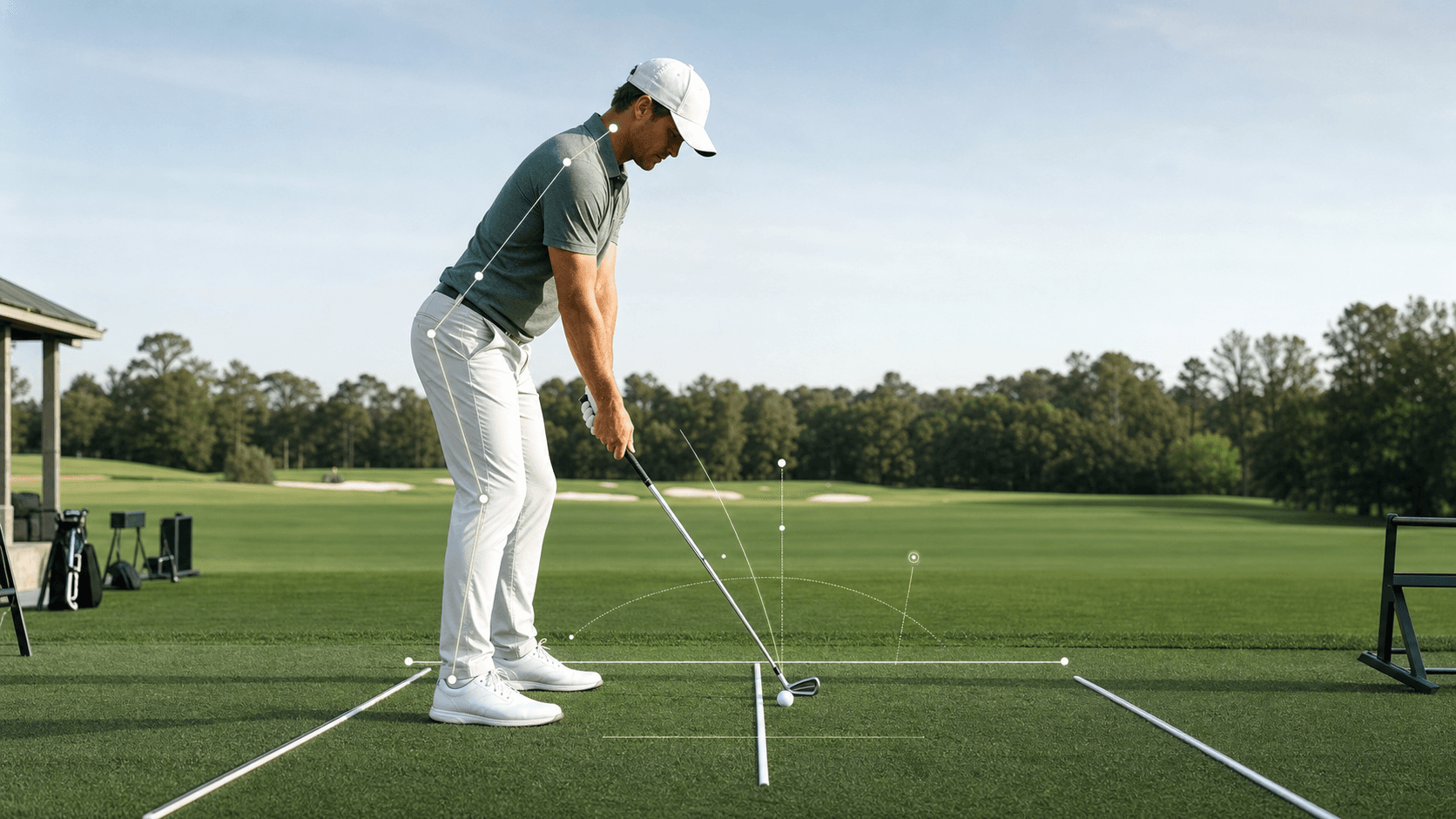
Golf is a game of precision, but it's also a game of trust. Many weekend golfers find themselves trapped in a cycle of overthinking, loading up on swing thoughts before, during, and even after every shot. This mental clutter often leads to tension, inconsistency, and a loss of enjoyment. As Chubbs, your Straight Line Golf Pro AI swing coach, my goal is to help you simplify your approach and play golf with more freedom and better results.
The desire to improve is commendable, but sometimes, in our quest for the perfect swing, we inadvertently complicate the process. We gather tips from various sources, try to implement multiple adjustments at once, and end up with a mind full of conflicting instructions. This article will guide you on how to streamline your mental game, allowing your body to execute the swing you've practiced, rather than trying to construct it on the fly.
Quick Answer
To play golf with fewer swing thoughts, focus on developing a consistent, concise pre-shot routine that builds trust in your practiced swing. Shift your attention from internal swing mechanics to external targets and desired ball flight. Practice deliberately to ingrain movements, then commit to a single, clear intention for each shot on the course, allowing your athletic instincts to take over.
The Overthinking Trap: Why More Thoughts Don't Lead to Better Golf
It's a common pattern: you hit a bad shot, and immediately your mind races to identify what went wrong. "Was my clubface open? Did I sway? Was my wrist bent incorrectly?" This internal monologue, while well-intentioned, often spills over into the next shot. You step up to the ball, and suddenly you're trying to remember five different swing keys, each designed to fix a perceived flaw.
The Issue: Attempting to consciously control multiple complex movements during the golf swing. The Reason: A belief that more conscious control equates to better execution, often fueled by a fear of repeating past mistakes or a misunderstanding of how the golf swing works. The golf swing is a dynamic, athletic motion that benefits from fluidity and instinct, not micro-management. The Impact: This "paralysis by analysis" leads to several detrimental outcomes:
- Tension: Mental clutter translates directly into physical tension in your hands, arms, and shoulders, restricting your natural movement.
- Loss of Rhythm and Tempo: When you're thinking too much, your swing becomes segmented and jerky, losing the smooth flow essential for power and consistency.
- Decision Fatigue: Constantly processing swing thoughts drains your mental energy, making it harder to focus on strategy and course management.
- Lack of Trust: You stop trusting your body and your practice, leading to doubt and hesitation over the ball.
The path to playing golf with fewer swing thoughts isn't about ignoring technique entirely. It's about shifting *when* and *where* you focus on technique. The practice range is for building and refining your swing. The golf course is for trusting it.
Pillar 1: Trust Your Practice – The Foundation of Fewer Thoughts
The most effective way to reduce swing thoughts on the course is to build a swing you can trust off the course. This means deliberate, focused practice.
The Issue: Bringing swing mechanics from the practice range directly to the golf course. The Reason: Inconsistent practice habits, or practicing without a clear purpose, can lead to a lack of confidence in your swing when it matters most. If you're constantly experimenting on the range, you won't have a solid foundation to fall back on. The Fix: Structure your practice sessions. Instead of hitting balls aimlessly, pick one specific aspect of your swing to work on per session. Focus on it, get feedback (perhaps by recording your swing and uploading it to /upload for self-analysis or sharing with a coach), and then move on. Once you've ingrained a movement, practice hitting shots with *no* swing thoughts, simply focusing on the target.
The "One-Thought Practice" Drill:
- Choose One Focus: For an entire bucket of balls, pick *one* single swing thought. This could be "smooth takeaway," "full turn," or "finish tall."
- Commit: For every shot, your only conscious thought related to your swing is that one chosen focus.
- Evaluate: After the bucket, assess how that single focus impacted your shots. Did it help? Did it hinder? This teaches you the power of singular focus versus mental overload.
- Transition: As you get closer to a round, dedicate a portion of your practice to hitting shots with *zero* swing thoughts, purely focusing on the target and feel. This simulates course conditions.
This drill helps you understand that often, one clear intention is more effective than a dozen vague ones. To describe the pattern and choose one next step, start an AI coaching conversation with Chubbs.
Pillar 2: Define Your Pre-Shot Routine – Your Mental Launchpad
A consistent pre-shot routine is your most powerful tool for shedding excess swing thoughts. It's a sequence of actions that prepares you mentally and physically for the shot, signaling to your brain that it's time to execute, not analyze.
The Issue: An inconsistent or overly long pre-shot routine, or no routine at all, leading to hesitation and a rush of last-minute swing thoughts. The Reason: Without a structured routine, your mind is left to wander, picking up old doubts or new instructions. You might rush, or conversely, take too long, allowing doubt to creep in. The Fix: Develop a concise, repeatable pre-shot routine that you perform for every shot, from driver to putt. It should be a sequence of physical and mental steps that takes no more than 10-15 seconds.
A Sample Pre-Shot Routine (Adapt to your preference):
- Assess: Walk behind the ball, visualize your target, and determine your desired ball flight. Pick an intermediate target a few inches in front of your ball. (1-2 seconds)
- Feel: Take one or two relaxed practice swings, focusing purely on the *feel* of the swing, not mechanics. (3-5 seconds)
- Address: Step into the ball, align your clubface to your intermediate target, then align your body. (3-5 seconds)
- Commit: Take one final look at your target, take a deep breath, and let go of all swing thoughts. Focus solely on the target and the intention to hit it. (1-2 seconds)
- Swing: Execute the shot.
Practical Checkpoint: The "Pre-Shot Routine Snapshot" Before you step over the ball, ask yourself: "Have I completed all steps of my routine, and is my mind clear with only a target focus?" If the answer is no, step away, reset, and repeat your routine. This checkpoint helps you enforce consistency and prevent rushing into a shot with a cluttered mind.
Pillar 3: Focus on the Target, Not the Mechanics
Once you've completed your pre-shot routine and committed to the shot, your focus should shift entirely to the external.
The Issue: During the swing, your mind is focused on internal mechanics (e.g., "keep my left arm straight," "rotate my hips"). The Reason: A misunderstanding of how the body learns and executes complex motor skills. Conscious thought during an athletic movement often interferes with the natural flow. The Fix: Shift your attention from *how* you're going to swing to *where* the ball is going to go. Think about the target, the trajectory, the flight of the ball. This external focus allows your subconscious mind, which has absorbed all your practice, to take over and execute the swing.
The "Target-Only Swing" Drill:
- Set Up: Place a target flag or alignment stick 100-150 yards away.
- Pre-Shot: Go through your full pre-shot routine, visualizing the ball flying directly to that target.
- Execute: As you begin your swing, your *only* conscious thought is the target. Imagine the ball leaving the clubface and soaring precisely to that point. Do not think about your hands, hips, or clubface.
- Repeat: Hit a series of shots with this singular, external focus. Notice how your body often finds a more natural, fluid motion when the mind is freed from internal commands.
This drill helps train your mind to trust your body's ability to respond to a clear external goal.
Pillar 4: Embrace Imperfection and Adapt
Golf is not a game of perfect shots; it's a game of managing misses. Expecting every shot to be flawless is a surefire way to generate more swing thoughts when things inevitably go awry.
The Issue: Striving for a perfect swing and perfect outcome on every shot. The Reason: Unrealistic expectations, often fueled by watching professional golfers or highlights. The Fix: Accept that golf is a game of variables – lies, wind, pressure, and your own human error. Your goal is to make the best swing *you can* on *that particular shot*, not to replicate a textbook ideal. When a shot isn't perfect, acknowledge it, learn from it briefly, and then immediately shift your focus to the next shot.
This acceptance reduces the pressure to perform perfectly, which in turn reduces the need to constantly "fix" your swing in your head.
Pillar 5: The Post-Shot Review (Brief and Constructive)
While the focus during the swing should be minimal, a brief, constructive post-shot review can be helpful *after* the ball has landed.
The Issue: Dwelling on bad shots, carrying negative thoughts, or immediately trying to overhaul your swing after one poor result. The Reason: A natural human tendency to analyze and fix mistakes, but applied at the wrong time or in an unproductive way. The Fix: After a shot, take a moment to observe the outcome. If it was good, acknowledge it. If it wasn't, briefly consider *one* potential cause (e.g., "I rushed that," "I didn't commit to the target"). Do *not* overanalyze or try to implement multiple fixes. Then, consciously let it go and shift your focus to the next shot and your pre-shot routine. This prevents negative thoughts from accumulating and influencing subsequent swings.
Integrating Technology for Clarity
Sometimes too many swing thoughts come from uncertainty about the motion. One clear clip can add visual evidence.
If you are constantly guessing, record one clear swing from one angle and upload the clip for a video-informed Chubbs AI review. To add context, start an AI coaching conversation. The report can narrow practice to one visible priority, but it does not provide a definitive mechanical answer.
Remember, the goal isn't to think *less* about golf, but to think *smarter* about it. Reserve your analytical thoughts for practice and post-round reflection, and free your mind to execute on the course.
Quick Checklist: Playing With Fewer Swing Thoughts
- Practice with Purpose: Dedicate practice time to ingrain one specific swing element, then practice hitting shots with no mechanical thoughts, just target focus.
- Solidify Your Routine: Develop a consistent, concise pre-shot routine and commit to performing it for every shot.
- Target-Oriented Focus: During your routine's final steps and throughout your swing, shift your entire focus to your external target and desired ball flight.
- Embrace Imperfection: Accept that not every shot will be perfect. Learn to manage your misses rather than striving for unattainable perfection.
- Brief Post-Shot Review: After a shot, take a moment to learn one thing, then immediately let it go and focus on the next shot.
- Use a Bounded Checkpoint: If uncertainty persists, `/upload` can provide a Chubbs AI observation about what is visible in one clip, while `/coach` is an AI conversation where you can add context. Treat any suggested priority as a practice hypothesis, not an exact measurement or diagnosis of the underlying cause.
Frequently Asked Questions (FAQ)
**Q: Can I eliminate *all* swing thoughts?** A: The goal isn't necessarily to eliminate *all* thoughts, but to eliminate *unproductive* thoughts. You'll always have an intention (e.g., "hit it straight," "fade it"). The aim is to reduce conscious, mechanical instructions during the swing itself, allowing your athletic instincts to take over.
Q: How long does it take to reduce swing thoughts? A: It varies for each golfer. Consistency in deliberate practice and routine implementation is key. You might notice small improvements within a few rounds, but significant shifts in your mental game often take weeks or months of consistent effort. It's an ongoing process of building trust and simplifying.
Q: What if I still feel stuck or overwhelmed with thoughts? A: This is a common challenge. If you're struggling to implement these strategies on your own, consider seeking personalized guidance. Sometimes, an outside perspective is what's needed to break old habits. To describe the pattern and choose one next step, start an AI coaching conversation with Chubbs.
**Q: Is it okay to have *any* swing thoughts at all?** A: Absolutely. During practice, swing thoughts are essential for making technical adjustments and improvements. The distinction is *when* you have them. On the course, the ideal is to have one clear, simple intention (often related to the target or feel), rather than multiple mechanical instructions. A single, positive swing thought can sometimes be a good trigger for a feeling you've practiced. The key is *simplicity* and *trust*.
Conclusion
Playing golf with fewer swing thoughts is not about being mindless; it's about being more intentional. It's about doing the hard work on the practice range so that on the course, you can free your mind to focus on the target and trust your swing. By simplifying your routine, shifting your focus, and embracing the imperfect nature of the game, you'll not only enjoy your rounds more but also likely see a significant improvement in your consistency and scores. Embrace the power of simplicity, and let your best golf emerge.