

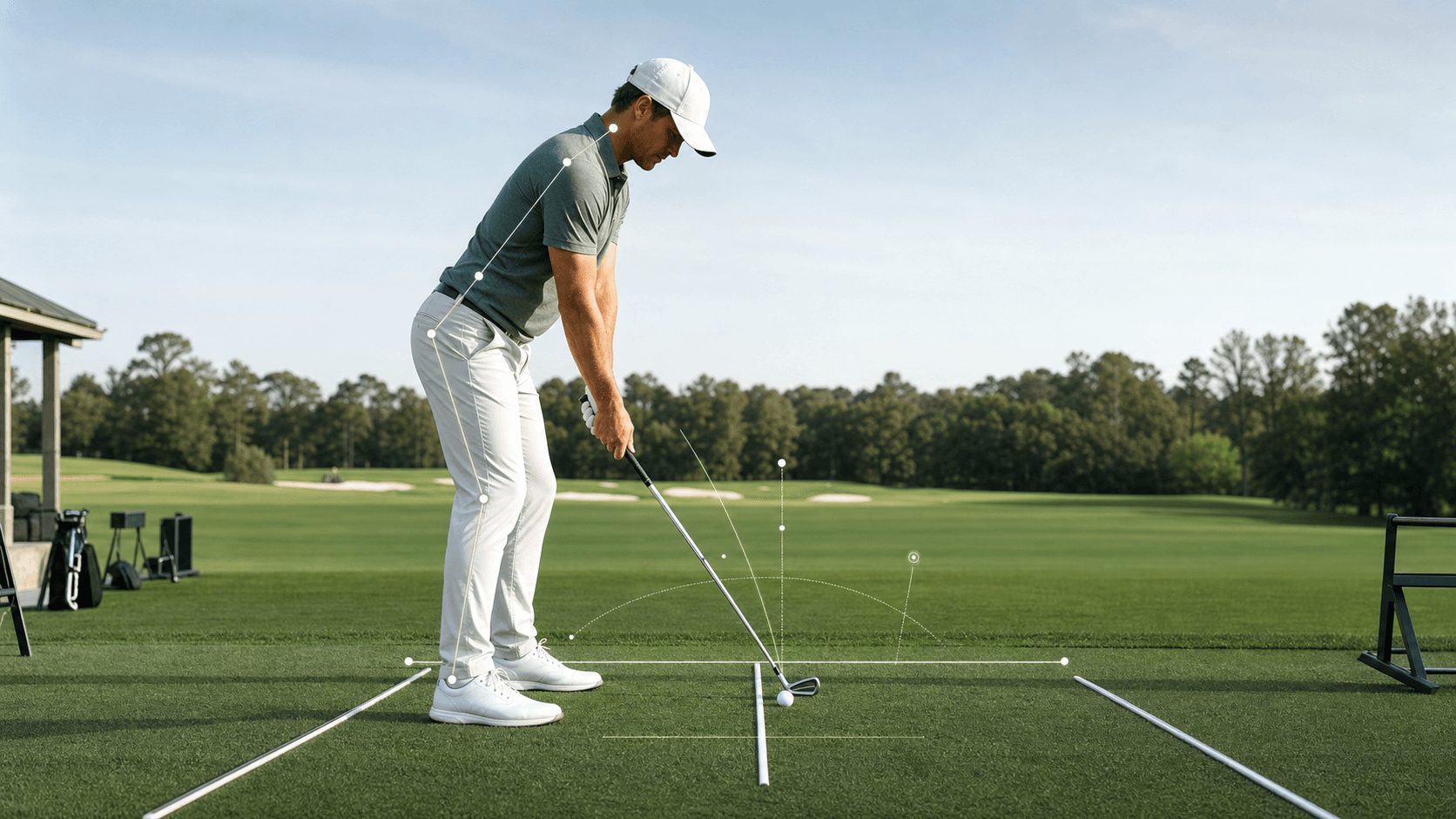
Hitting a golf ball with the center of the clubface, especially on approach shots, is one of the most satisfying feelings in golf. More importantly, it's the foundation for consistent distance control and accuracy, allowing you to hit more greens in regulation and set up easier birdie putts. For many weekend golfers, the difference between a great round and an average one often comes down to the quality of their iron contact.
This article will guide you through the principles of achieving more solid contact on your approach shots. We'll break down the common reasons for inconsistent strikes and provide clear, actionable steps to improve. Our focus at Straight Line Golf Pro (SLGP) is on fundamental movements that lead to predictable results.
Quick Answer
To hit more solid approach shots, focus on maintaining a stable body posture throughout your swing, ensuring your low point (the lowest point of your clubhead's arc) is consistently ahead of the ball. Achieve this by setting up with proper ball position for irons, making a controlled backswing that maintains your spine angle, and initiating the downswing with a smooth weight shift towards your lead side, allowing your body rotation to deliver the club to the ball. Avoid lifting your body or trying to "scoop" the ball into the air.
Understanding Solid Contact
What exactly does "solid contact" mean when we talk about approach shots with irons? It means striking the golf ball first, followed by a shallow divot (or simply brushing the turf) *after* the ball. This is often referred to as hitting "down and through" the ball. When you achieve this, the ball compresses against the clubface effectively, launching with optimal spin and speed.
Conversely, unsolid contact can manifest in several ways:
- Thin shots (blades): Hitting too high on the ball, often above the equator, resulting in a low, uncontrolled flight.
- Fat shots (chunks): Hitting the ground significantly before the ball, leading to a loss of power and distance.
- Toe or Heel shots: Striking the ball off-center horizontally, causing the ball to fly offline and lose distance.
Each of these inconsistent strikes stems from a deviation in the clubhead's path or its low point relative to the ball at impact. Our goal is to stabilize these elements.
Common Issues Leading to Unsolid Contact
Many golfers struggle with solid contact due to a few predictable patterns. Let's examine these one by one, focusing on the issue, its likely reason, and a clear fix.
Issue 1: Inconsistent Low Point
Your low point is the lowest point in your clubhead's arc during the swing. For solid iron contact, this low point needs to be consistently *after* the ball. If it's before the ball, you'll hit fat shots. If it's too far after the ball, or if your clubhead is rising too much at impact, you'll hit thin shots.
- Likely Reason: Excessive body movement, such as swaying, lifting, or dropping during the swing. When your head or hips move significantly off their initial setup position, it becomes very difficult to return the club to the same precise low point consistently.
- The Fix: Maintain a Stable Center. Focus on rotating your body around a relatively fixed central axis. Imagine a rod running from the top of your head down through your spine and into the ground. Your goal is to rotate around this rod, rather than moving it side to side or up and down. During the backswing, allow your lead shoulder to turn down and under, and on the downswing, feel your lead hip clear out of the way, creating space for the club. This rotation helps you deliver the club on a consistent plane.
Issue 2: Poor Weight Transfer
An effective golf swing involves a dynamic transfer of weight. For approach shots, this means shifting your weight to your lead side as you initiate the downswing and through impact.
- Likely Reason: Staying too much on your trail foot through impact, or transferring your weight prematurely and losing balance. Staying on the trail foot often leads to scooping or trying to lift the ball, resulting in thin or fat shots because the low point shifts backward. Premature transfer can cause you to fall forward, disrupting your club path.
- The Fix: Gradual, Athletic Shift. On the backswing, allow your weight to naturally shift to your trail side. As you transition to the downswing, feel the pressure shift smoothly to your lead foot. Think of it as pushing off your trail foot and rotating onto your lead side. By impact, the majority of your weight should be on your lead side, allowing you to hit down and through the ball. This isn't a violent lunge, but a controlled, athletic movement that powers your rotation.
Issue 3: Early Extension or Casting
Early extension is when your hips move closer to the ball and your spine angle changes (you stand up) during the downswing. Casting, or "throwing the club from the top," is when you lose your wrist hinge early in the downswing. Both issues often go hand-in-hand.
- Likely Reason: A common attempt to "help" the ball into the air, or a compensation for a lack of proper body rotation. When you early extend, you lose the space needed for your arms to swing freely, often forcing you to cast the club to reach the ball, leading to inconsistent contact (often thin or fat).
- The Fix: Maintain Your Posture and Lag. Focus on maintaining your spine angle from setup through impact. Imagine your hips rotating *around* your spine angle, rather than pushing towards the ball. For lag, feel your wrists maintain their angle longer into the downswing. This creates a powerful release point closer to the ball. A good thought is to keep your back to the target slightly longer at the start of the downswing, allowing your lower body to initiate the movement and create space.
Issue 4: Inconsistent Clubface Control
Even with a perfect low point and swing path, if your clubface isn't square at impact, you'll hit offline shots or lose power.
- Likely Reason: Over-reliance on hands and wrists to manipulate the clubface, rather than allowing the body's rotation to square it naturally. This can lead to an open or closed clubface at impact.
- The Fix: Square Clubface Through Body Rotation. The goal is to set your clubface square at address and then allow your body's rotation to return it to that square position at impact. Avoid excessive manipulation with your hands. Focus on a good, neutral grip that allows your wrists to hinge and unhinge naturally. Feel your chest and hips rotating through the shot, pulling the clubface square. The clubface should feel like an extension of your body's rotation.
The SLGP Approach to Solid Approach Shots
At Straight Line Golf Pro, we emphasize simplicity and consistency. Our approach to solid approach shots is built on a few core principles:
- Fundamental Setup: Your setup is your blueprint for the swing.
- Ball Position: For most irons, the ball should be positioned roughly in the middle of your stance, or slightly forward of center for longer irons. This promotes hitting the ball first with a descending blow.
- Posture: Stand athletically, with a slight bend from your hips, knees slightly flexed, and your arms hanging naturally. This creates the optimal spine angle to rotate around.
- Grip: A neutral grip allows the clubface to remain stable throughout the swing.
- The Stable Low Point: As discussed, this is paramount. Think of your body as an anchor, and your arms and club as the pendulum swinging around it. The more stable the anchor, the more consistent the pendulum's lowest point.
- The "Straight Line" Concept: While the clubhead travels on an arc, the principle of the "straight line" applies to your body's axis and the intended target line through impact. Maintain a consistent spine angle and hip line, allowing the club to travel efficiently towards the target on a consistent path. This isn't about swinging in a literal straight line, but about minimizing unnecessary lateral or vertical movement that disrupts the club's intended path.
Practical Checkpoint: The "Stable Base Check"
Before you even take the club back, you can check if you're set up for a stable swing.
How to Perform:
- Set up to the ball as you normally would for an iron shot.
- Without moving your head or upper body, try to gently lift your lead foot's heel off the ground for a second, then place it back down.
- Repeat with your trail foot's heel.
- If you find yourself wobbling excessively or needing to shift your body significantly to lift a heel, it suggests your weight distribution is off, or your stance is too wide, making it harder to maintain a stable base during the dynamic motion of the swing.
The Goal: You should feel balanced and stable enough to perform this check with minimal effort. This confirms you have a solid foundation for rotation without excessive swaying. Adjust your stance width or weight distribution until you feel grounded and balanced.
Named Drill/Test: The "Towel Drill for Low Point Control"
This drill is excellent for improving your low point consistency and eliminating fat shots.
How to Perform:
- Place a small hand towel or headcover on the ground, about 3-6 inches *behind* your golf ball. The exact distance will depend on your club and comfort level, but start closer and move it back if you consistently avoid it.
- Set up to the ball as usual, ensuring the towel is clearly visible behind it.
- Your goal is to hit the golf ball cleanly without touching the towel. You want to strike the ball first, and then take a divot (or brush the turf) *after* where the ball was, well past the towel.
What it Teaches:
- Low Point Awareness: This drill forces you to focus on bringing the club down and through the ball without hitting the ground prematurely.
- Descending Blow: It encourages the proper descending angle of attack needed for solid iron contact.
- Body Rotation: To avoid the towel, you'll naturally engage your lower body and rotate through the shot, rather than trying to scoop or lift with your hands.
Start with half swings, focusing purely on avoiding the towel and making clean contact. As you get more comfortable, gradually increase your swing speed and length. This drill directly addresses the most common cause of fat shots – an inconsistent low point.
Putting It All Together: Practice and Application
Improving solid contact isn't a quick fix; it requires focused practice. Dedicate specific practice sessions to these concepts:
- Start Small: Begin with half swings, focusing purely on the feeling of hitting the ball first and brushing the turf *after*.
- Use Feedback: Pay attention to the sound and feel of your shots. A solid strike has a distinct, crisp sound and a satisfying feel.
- Vary Your Clubs: Practice with different irons (short, mid, and long) to understand how ball position and swing dynamics might subtly change.
- Simulate the Course: On the range, don't just hit ball after ball. Imagine you're on the course, hitting to a specific target. This adds a layer of pressure and focus.
If you're finding it hard to identify a pattern, upload a clear swing video for a video-informed Chubbs AI review. It can flag visible tendencies related to contact and balance, but it cannot pinpoint an exact physical cause from video alone. Use /coach to add the club, lie, strike, and ball flight in an AI conversation.
Remember, the goal is consistency. Small, repeatable improvements will lead to significant results on the course.
Quick Checklist for Solid Approach Shots
- Stable Setup: Ball position appropriate for irons (middle to slightly forward), athletic posture, neutral grip.
- Stable Center: Rotate around a relatively fixed central axis; avoid excessive swaying, lifting, or dropping.
- Smooth Weight Shift: Shift pressure to your lead side during the downswing and through impact.
- Maintain Posture: Keep your spine angle consistent from setup through impact; avoid early extension.
- Body-Driven Swing: Let your body rotation power the swing and square the clubface, rather than manipulating with hands.
- Practice Low Point Control: Use drills like the "Towel Drill" to ensure you hit the ball first.
- Focus on Feel: Pay attention to the crisp sound and solid feel of good contact.
Frequently Asked Questions (FAQ)
Q: How does ball position affect solid contact with irons? A: For irons, placing the ball roughly in the middle of your stance (or slightly forward for longer irons) encourages a descending blow. This allows the club to strike the ball first, then take a shallow divot after, which is ideal for solid contact and spin. If the ball is too far forward, you might catch it on the upswing (thin); too far back, and you might hit down too steeply or hit fat.
Q: What if I consistently hit it thin? A: Consistently thin shots often indicate that your clubhead is rising too much at impact, or your low point is too far ahead of the ball, causing you to catch the top half of the ball. This can be due to lifting your body, trying to "help" the ball up, or an insufficient weight transfer to your lead side. Focus on maintaining your spine angle, shifting your weight, and ensuring a slight descending angle of attack.
Q: What if I consistently hit it fat? A: Consistently fat shots mean your low point is occurring *before* the ball, causing you to hit the ground first. This is typically a result of swaying off the ball, dropping your body during the downswing, or failing to transfer your weight to your lead side. The "Towel Drill" is excellent for addressing this. Focus on keeping your head stable and rotating your body through the shot.
Q: Should I try to hit down on the ball with irons? A: Yes, for most iron shots, a slight descending blow is desirable. This doesn't mean digging a huge trench, but rather ensuring the clubhead is still traveling slightly downwards as it strikes the ball. This compression is what generates proper spin and trajectory. Think "ball first, then turf."
Conclusion
Achieving more solid approach shots is a cornerstone of consistent golf. By understanding the common patterns that lead to inconsistent contact and focusing on fundamental movements like maintaining a stable body, proper weight transfer, and controlling your low point, you can significantly improve your ball striking. Remember, golf is a journey of continuous learning and refinement. Be patient with yourself, practice with purpose, and celebrate the small improvements that lead to more satisfying and effective shots on the course.