

Welcome to the first tee of your golf journey. My name is Chubbs, and I'll be your guide here at Straight Line Golf Pro. Taking up this great game can feel like learning a new language, but I promise you, with a little patience and the right fundamentals, you'll be finding joy on the fairways in no time.
Many new golfers, especially women, feel intimidated when they start. They see complex swings on TV, hear a lot of confusing jargon, and worry about looking silly. Let's push all that aside. Golf isn't about perfection, especially not at the beginning. It's about getting outside, challenging yourself, and hitting that one pure shot that makes you fall in love with the game.
This guide is your foundation. We're not going to overload you with a hundred different swing thoughts. Our philosophy is simple: one issue, one reason, one fix. We'll walk through everything you need to know, from what to wear to how to hold the club, so you can step onto the course with confidence.
Let's get started.
Quick Answer: Top 5 Golf Tips for Women Beginners
For those ready to jump right in, here are the most important things to focus on as you begin your golf journey:
- Master a Light, Correct Grip: Your hands are your only connection to the club. Hold it in your fingers, not your palms, with light pressure—like holding a bird without letting it fly away. This allows the club to work for you.
- Focus on Balance and Posture: A good swing starts from the ground up. Stand with your feet shoulder-width apart, bend from your hips (not your waist), and let your arms hang naturally. A balanced stance is a powerful stance.
- Swing Smooth, Not Hard: Don't try to pulverize the ball. Power comes from rhythm and good contact, not brute force. Think of a smooth, sweeping motion, letting the club's momentum do the work.
- Start with the Short Game: Spend time on and around the putting green. Chipping and putting build feel and confidence, and it's where you'll save the most strokes. A good putt counts the same as a 200-yard drive.
- Learn Basic Etiquette and Have Fun: Knowing a few simple rules about pace of play and caring for the course will make you feel much more comfortable. Most importantly, remember it's a game. Laugh at the bad shots and celebrate the good ones.
---
Part 1: Gearing Up and Getting Started
Before you even think about swinging, let's cover the basics of getting ready. Feeling comfortable and prepared is the first step to building confidence.
What to Wear: Comfort is Key
You don't need a designer wardrobe to play golf, but you do need to be comfortable. Most courses have a simple dress code, which usually means no jeans, tank tops, or short shorts.
- Tops: A collared polo shirt (with or without sleeves) is the standard. Many brands now make stylish and comfortable golf tops from breathable, moisture-wicking fabrics.
- Bottoms: Golf skirts, skorts, capris, or tailored shorts are all great options. Khaki or golf-specific trousers work well, too. The key is choosing something that allows for a full range of motion.
- Footwear: You don't need to buy expensive golf shoes on day one. A comfortable pair of athletic sneakers will work just fine at the driving range. When you do decide to buy golf shoes, you'll notice they provide much better traction and stability.
- Outerwear: Golf is often played in the early morning or on breezy days. A light windbreaker, a vest, or a quarter-zip pullover is perfect for layering.
- Don't Forget: A hat or visor for sun protection is a must!
Your First Clubs: The Essential Starter Set
Walking into a golf shop can be overwhelming. You'll see walls of shiny, expensive clubs. You do not need a full 14-club set to start. In fact, it's better to learn with fewer clubs.
If you're not ready to buy, many driving ranges and courses rent clubs. If you are ready, look for a beginner's "package set." These are designed to be more forgiving and come with everything you need.
A great starter set would include:
- A Driver: The big club used for hitting off a tee on long holes. It's designed for maximum distance.
- A Hybrid (like a 4 or 5-hybrid): These clubs are a modern godsend for beginners. They are much easier to hit than long irons and are great from the fairway or light rough.
- A few Irons (7-iron, 9-iron, Pitching Wedge): The 7-iron is a perfect mid-range club for learning the fundamentals of the iron swing. The 9-iron and Pitching Wedge are used for shorter approach shots into the green.
- A Putter: Used on the green to roll the ball into the hole. This is arguably the most important club in your bag.
That's it. Five or six clubs are more than enough to learn the game and have a great time on the course.
Where to Practice: The Driving Range is Your Friend
Don't feel pressured to get onto an 18-hole course right away. The best place to learn is the driving range.
- The Driving Range: Here, you can hit a whole bucket of balls without worrying about where they go. It's a low-pressure environment perfect for working on your grip, stance, and swing motion without the stress of finding your ball or holding up other players.
- The Putting Green: Most ranges and courses have a practice putting green. Spend at least half your practice time here. It's where you'll truly learn to score.
- Par-3 Courses: Once you're making consistent contact at the range, a par-3 or "executive" course is the ideal next step. The holes are shorter, it's less intimidating, and it gives you a feel for playing a real round of golf.
Part 2: The Core Fundamentals - Your Swing's Foundation
Alright, let's get to the good stuff. A reliable golf swing is built on a few simple, repeatable fundamentals. We'll break them down one by one.
The Grip: Your Only Connection to the Club
How you hold the club influences everything that follows. A bad grip forces you to make compensations elsewhere in your swing.
- The Issue: Most beginners grip the club too tightly and place it in the palms of their hands.
- The Reason: A "death grip" creates tension in your arms and shoulders, killing your ability to generate clubhead speed. A palm grip limits the natural hinging of your wrists, which is a key source of power.
- The Fix: Hold the club primarily in the fingers of your lead hand (the left hand for a right-handed golfer). When you look down, you should be able to see the knuckles of your index and middle fingers. Now, place your trail hand on the club. You have three main options:
- Ten-Finger (or Baseball) Grip: All ten fingers are on the club. This is often the most natural for beginners.
- Interlocking Grip: The pinky finger of your trail hand links with the index finger of your lead hand.
- Vardon (or Overlapping) Grip: The pinky finger of your trail hand rests on top of the space between your lead index and middle fingers.
Try all three and see what feels most comfortable and secure. Your grip pressure should be a "4" on a scale of 1 to 10. Firm enough not to lose control, but light enough to feel the weight of the clubhead.
Stance & Posture: Building a Balanced Base
Your body is the engine of the golf swing. A stable, athletic posture allows that engine to work efficiently.
- The Issue: Standing too tall and rigid, or hunched over in a slump.
- The Reason: Poor posture destroys your balance. If you're not balanced, you can't make a consistent, repeatable swing.
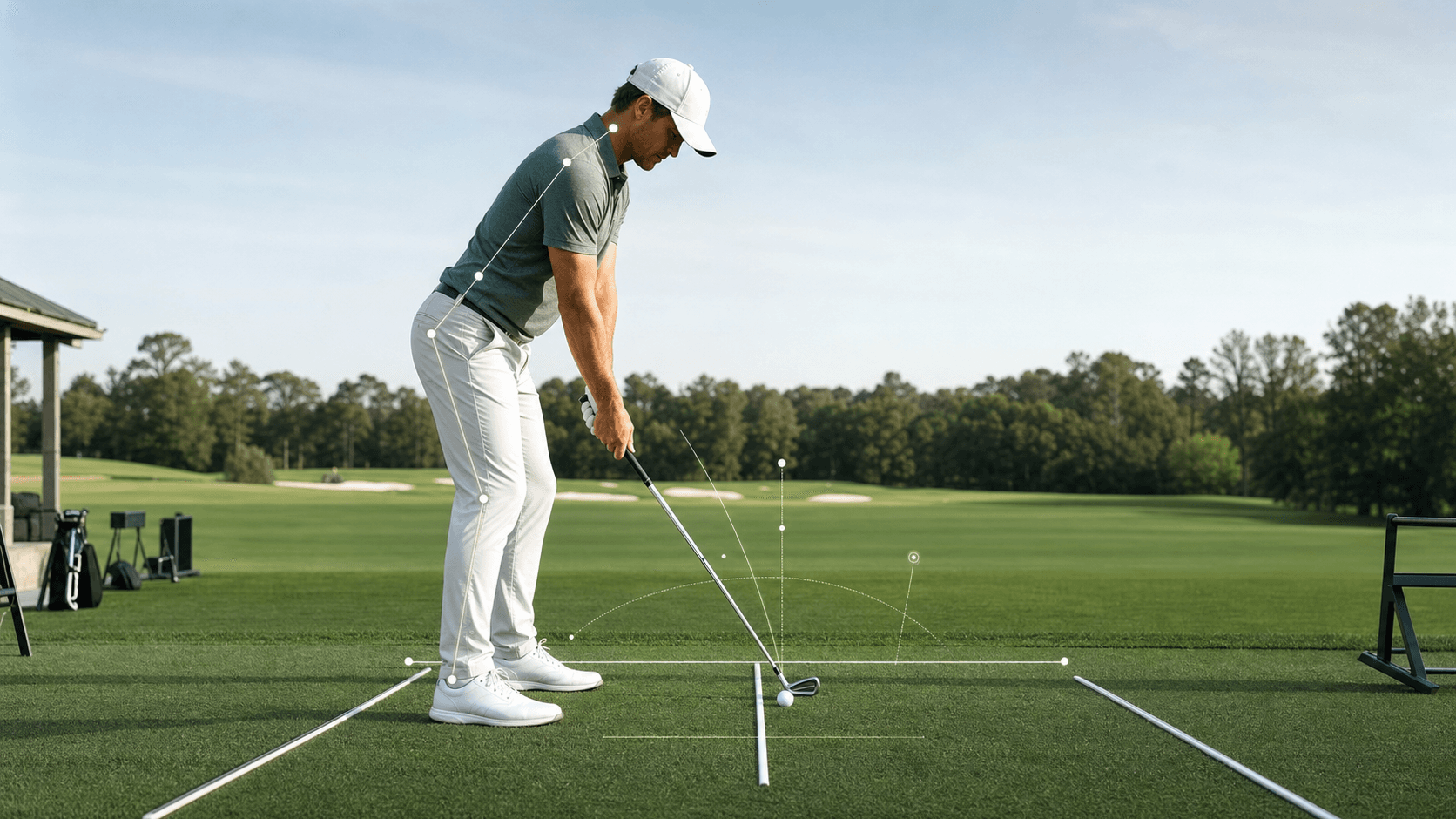
- The Fix: Let's build your posture from the ground up.
- Feet: Stand with your feet about shoulder-width apart for an iron shot. Your weight should be balanced evenly between your feet and centered over the balls of your feet, not your heels or toes.
- Knees: Flex your knees slightly, just enough to feel athletic and ready to move.
- Hips: This is the most important part. Bend forward *from your hips*, keeping your back relatively straight. Don't just round your shoulders.
- Arms: Let your arms hang down naturally from your shoulders. The end of the club should be about a hand's width away from your body.
This athletic posture should feel balanced and powerful, ready to support a full turn.
Alignment: Aiming for Success
This is one of the most common mistakes beginners make. You can make a perfect swing, but if you're aimed in the wrong direction, you'll get a bad result.
- The Issue: Aiming your feet and body directly at the target.
- The Reason: Because the ball is not in the center of your body, aiming your body at the target actually sets your swing path "over the top," leading to slices (for a righty, a shot that curves hard to the right).
- The Fix: Use the "railroad tracks" analogy.
- Track 1 (The Ball-Target Line): Imagine one rail running from your ball straight to your target. Your clubface should be aimed squarely down this line.
- Track 2 (The Body Line): Imagine a second rail, parallel to the first one. Your feet, hips, and shoulders should all be aligned along this second rail. For a right-handed golfer, this means your body will be aimed slightly *left* of the target.
To practice this, pick an intermediate target—a leaf or spot of discolored grass a few feet in front of your ball that is on your target line. Align your clubface to that spot first, then set your body parallel to that line.
Part 3: The Motion of the Swing
With a good setup, the swing itself becomes much simpler. Think of it as a fluid motion, not a series of jerky positions.
The Takeaway: Starting as One Piece
The first few feet of the backswing set the tone for the entire motion.
- The Issue: Snatching the club away quickly with only your hands and wrists.
- The Reason: This disconnects your arms from your body, putting the club on a poor path and robbing you of the power that comes from a good body turn.
- The Fix: Initiate the swing with a "one-piece takeaway." Feel like your arms, hands, shoulders, and chest all start turning away from the ball together. The triangle formed by your arms and shoulders should stay intact for the first few feet. This ensures your swing starts with width and connection.
The Downswing: Firing from the Ground Up
This is where power comes from. It's a sequence, and it starts from the bottom.
- The Issue: Starting the downswing by throwing the club from the top with your hands and arms.
- The Reason: This is the classic "over-the-top" move that causes slices and weak contact. It's an inefficient use of energy.
- The Fix: The downswing should start with your lower body. As your backswing finishes, your first move down should be a slight shift of your weight onto your lead foot and a rotation of your hips toward the target. This "uncoiling" from the ground up creates lag and allows the club to drop into the correct path, letting your body's rotation deliver the club to the ball with speed. It's a feeling of pulling, not pushing.
Impact and Finish: The Grand Finale
Don't think of impact as the end of the swing. It's just a point you pass through on the way to a beautiful finish.
- The Issue: Stopping or slowing down the swing right after hitting the ball.
- The Reason: Decelerating into the ball is a major cause of poor shots. It shows a lack of commitment and trust in your swing.
- The Fix: Your goal is to swing *through* the ball to a full, balanced finish. After impact, let your arms extend toward the target and then fold up over your lead shoulder. Your body should be fully rotated, with your belt buckle facing the target. All your weight should be on your lead foot, and you should be able to hold your finish pose comfortably. A balanced finish is a sign of a good swing.
Part 4: The Recommended Drill - Tee-to-Turf Confidence Drill
Many beginners are afraid of hitting the ground. This simple drill is designed to build confidence and teach you what solid contact feels like.
- Goal: To swing through the ball and brush the grass without fear.
- Setup: Go to the driving range with a 7-iron.
The Steps:
- Tee it High: Place a ball on a high tee, as if you were hitting a driver. Make a smooth, easy swing and just clip the ball off the tee. Don't worry about power.
- Lower the Tee: Push the tee down into the ground about halfway. Hit another ball. Notice how you have to swing a little lower to make contact.
- Lower it Again: Push the tee down so the ball is just barely sitting above the grass. Make the same smooth swing. You should feel the clubhead just start to brush the turf after it hits the ball.
- No Tee: Now, place a ball on the grass right next to where the tee was. Your goal is to replicate that exact same feeling—swinging through the ball and brushing the grass in front of it.
Why it Works: This drill systematically removes the fear of hitting the ground. It proves to your brain and your body that you *can* make contact with the ball first and the turf second, which is the secret to a pure iron shot.
---
Part 5: On-Course Smarts & Etiquette
Knowing a few simple rules of the road will make your first few rounds much more enjoyable and less stressful.
- Pace of Play: This is the most important one. Keep up with the group in front of you. Be ready to hit when it's your turn. A good rule of thumb is to take only one practice swing. If you're having a tough hole, it's perfectly okay to pick up your ball and move on.
- Safety First: Always be aware of other players. Never swing when someone is standing close to you or in front of you. If you hit a shot that is heading toward another person, yell "FORE!" as loud as you can.
- Care for the Course: Golf courses are beautiful places, and we all have a role in keeping them that way.
- Rake Bunkers: If you hit into a sand trap, use the rake to smooth out your footprints and the mark from your shot.
- Fix Ball Marks: Your ball will often leave a small dent when it lands on the green. Use a tee or a divot tool to repair it.
- Respect the Greens: Never run on the greens or drag your feet. Avoid stepping in another player's putting line.
The most important rule? Have fun. Golf is a challenging game. You will hit bad shots. Everyone does, from beginners to tour pros. The key is to laugh them off, enjoy the walk, and celebrate the one great shot that keeps you coming back.
Your Next Step on the Fairway
This guide is your starting point, a foundation to build upon. Reading is one thing, but doing is another. The best way to improve is to get feedback on *your* unique swing.
It can be tough to compare feel with visible motion. One self-service starting point is a video-informed Chubbs AI review; it is not a human lesson or an exact swing measurement.
Take one clear video no longer than 15 seconds and use the upload page. Chubbs will flag one visible priority and suggest one fix and drill. Use the Chubbs conversation to add the miss, club, goal, and feel.
Just head over to our upload page to get started. It's the fastest way to turn these tips into a swing you can trust.
---
People Also Ask (PAA)
Q: What is the best golf club for a woman beginner to start with? A: The 7-iron is widely considered the best club for a beginner to learn with. It has enough loft to get the ball in the air easily but is short enough to be manageable. It's the perfect club for learning the fundamentals of posture, grip, and swing motion.
Q: Is golf hard for a woman to learn? A: Golf is challenging for everyone to learn, regardless of gender! However, women often have a natural advantage in tempo and flexibility, which are huge assets in the golf swing. The key is to focus on fundamentals and rhythm rather than trying to overpower the ball. With good instruction, it's a very learnable and rewarding game.
Q: How many lessons should a beginner golfer take? A: A series of 3 to 5 lessons is a fantastic start. This gives a professional instructor enough time to cover the core fundamentals (grip, stance, posture, full swing, chipping, and putting) and build a solid foundation. After that, occasional check-ups can help keep you on the right track.
Q: What is a good score for a beginner woman golfer? A: Don't even worry about your score for your first few rounds! The goal is to get comfortable, make contact, and have fun. If you must keep score, breaking 120 (an average of about 6-7 shots per hole) is a great milestone for a beginner playing a full 18-hole course.
Q: Do I need special golf shoes to start playing? A: No, you don't need golf shoes for your first few trips to the driving range. A comfortable pair of athletic trainers or sneakers will work perfectly fine. Once you start playing on the course more regularly, investing in golf shoes is a good idea as they provide significantly better grip, stability, and waterproofing.
---
A Note From Chubbs AI
This article was created by Chubbs AI for Straight Line Golf Pro. It presents familiar golf fundamentals in clear, simple language for an everyday player; it is not attributed to, reviewed by, or endorsed by named instructors.
This guide uses familiar golf fundamentals and a calm, step-by-step format. My goal is to help you choose one useful checkpoint and practice it without unnecessary noise.